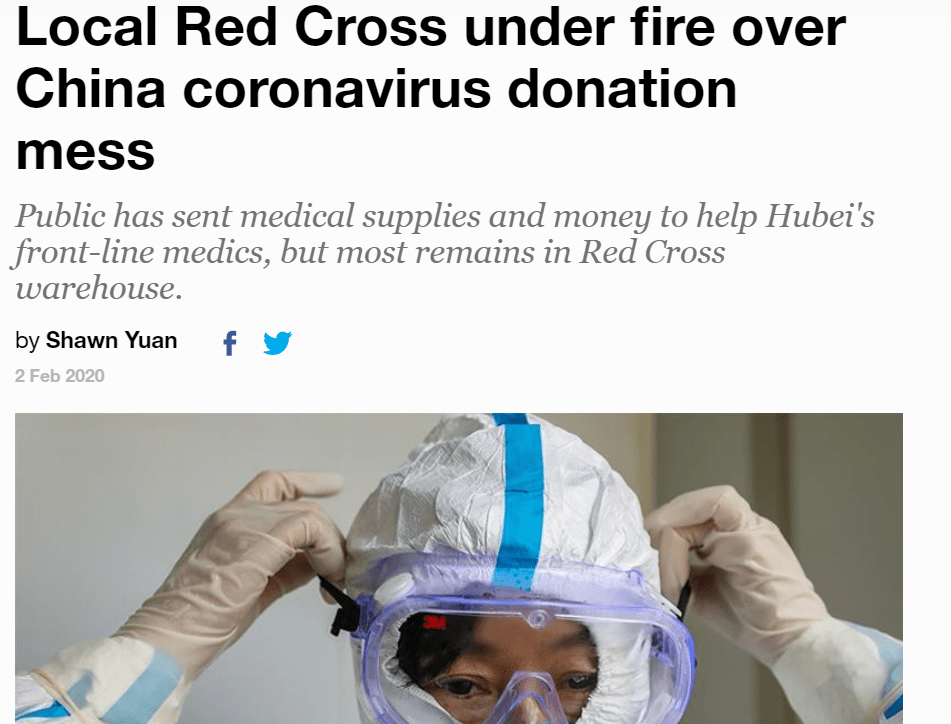
Source: (Yuan, 2020)
“Why are doctors still without protective gear after so many donations? Is Wuhan a black hole? (Ma, 2020)”
The Wuhan Red Cross in China has became the target of public anger during the battle with Coronavirus, as the donations of crucial medical supplies from across China failed to arrive at the hospitals on the front lines (Yuan, 2020). While the N95 masks were urgently needed and in shortage at the hospitals handling virus, those were given to private hospital specialising in cosmetic surgery and fertility treatment (Ma, 2020).
As social media exposed this desperate situation faced by doctors and nurses, the Chinese public tried to bypass the charities designated by the Chinese government and reached the front lines directly to send medical supplies, such N95 masks, protective gears and gloves.
Current Challenge
Where the donations go has always been a myth to the donors. Does it reach the people in need, or ends up being at the pocket of wrong people? According to the United Nations, although developed countries donate more than a billion dollars as foreign aid, around 30% of the money is lost to corruption and fraud. This is a problem that continues to confront governments, NGOs, and development agencies.
Imagine there’s a way to verify and reach out to those struggling individually in a fast and secure way, providing those people the support and possibly turning their life around. Thanks to Cryptocurrency and Blockchain technology – what we just talked about is NOT a dream.
Concepts Review
Let’s briefly review some of the basic concepts before we go through the new business model.
Blockchain: is a decentralized public ledger that maintains a transaction history and represents a “single source of truth” shared by all the network users (JP Vergne, C Lomazzo, Y Hsieh, N Ahmed, 2019). It is an essential component of many cryptocurrencies (Frankenfield, 2019).
Cryptocurrency: is a new form of digital asset based on a network that is distributed across a large number of computers. This decentralized structure allows them to exist outside the control of governments and central authorities (Frankenfield, 2019).
Smart Contract: A smart contract is a self-executing contract with the terms of the agreement between buyer and seller being directly written into lines of code. Smart contracts permit trusted transactions and agreements to be carried out among disparate, anonymous parties without the need for a central authority, legal system, or external enforcement mechanism (Frankenfield, Smart contracts, 2019).
Digital Wallet: A digital wallet is a system that securely stores users’ payment information and passwords for numerous payment methods and websites (Kagan, 2018).
The Charity Sector
Old Business Model: as explained, the left side of the picture below is the current situation where the donor doesn’t know when, where, whom, how much the donation is given. Due to the lack of transparency and trust, it was not surprising that all the continents, except Africa, reduced charitable giving in 2016 (Kothari, 2017)
New Business Model: on the right side though, the donor accesses a user-friendly interface that allows him or her to rank the order of favourite charities, and the donor could purchase desired cryptocurrency and donate through the digital wallet. The transaction will get recorded on blockchain and locked by a smart contract, which makes the transaction traceable and irreversible. The recipient will get notified and receive the donation, after which the blockchain is updated. Little Phil Coin, the company in the featured image below which goes over and beyond, crates a token based economic system which rewards the donation content creators (charitable organizations in the traditional model) based on reactions obtained from the donors. When the receiver sends an expression of gratitude to a giver (for example, a photo with the donated N95 masks), it provides a better connection between the donor and the recipient.

Source: (Baltazar, 2019)
Competitive Advantages
The new way sounds a lot more effective and efficient, right? Now let’s compare the six dimensions listed below between the donations through charitable organizations’ traditional business model (centralized) vs. through cryptocurrency and blockchain technology (decentralized).
| Through the Traditional Way | Through Cryptocurrency & Blockchain Technology | |
| Transparency | Most organizations don’t share their ledgers with the public – donors have no idea where their donations go and whom benefit from these. | Donors can monitor the donated funds or supplies and witness their progression until they reach the recipients |
| Cost | The operating/ overhead cost of an organization can take a big chunk away from the donation itself | Automation eliminates the administration cost to a great extend-cut down overhead cost significantly |
| Speed | Case by case; for international transactions, it might take few days or weeks | Only takes a few hours (maximum) from the donors to the recipient, even for international transactions |
| Control | Dependent on a centralized governing body or institution; there could be constraints of the geographic boundaries | High level of decentralization; donation can reach anywhere in the world |
| Easiness | Many layers between the donors and the recipients – complicated | Fewer trusted intermediaries needed |
| Security | It depends on the charitable organization’s strength on internal control, cyber security, etc. | Easy to share and store digital data, and the immutable nature eliminate manipulation on the entries |
Looking Forward
It’s beyond doubt that the blockchain technology is disruptive to the charity section, so how do the charitable organizations respond? In order to figure that out, we first need to diagnose it.
Diagnosing: the innovation is categorized as Architectural, meaning the organization requires both NEW business model (transparent and traceable transactions shared with donors) and technical competence (blockchain technology) (Corning; Gary P. Pisano, 2015).
Respond: in order to bridge technology and business model gaps, the organization should bring architectural knowledge to the top, build inclusive identity, and retain control of end user experience.
Implement: some best practices are embracing open innovation and crowdsourcing (acknowledgement of the need to change), forming external alliance (partnership with Fintech companies), collaborating with stakeholders (provide the level of transparency needed to retain donors).
Conclusion
Can blockchain technology re-shape charity? Although the application of this technology is still in the early adoption stage, there is no doubt that donor nowadays need more transparency about their donations. Powered by the blockchain technology, the donations reach the recipients faster, at a lower cost, in a more secure way through the decentralized model. In order to respond to the disruptions in the industry, the charitable organizations need to bridge the existing technology and business model gaps sooner than later. Lastly, my heart goes out to the people who are fighting again the corona virus; humanity will win.
References
Baltazar, G. (2019, Oct 28). Reimagining Donations, Charity, and the Giving Market using Blockchain. Retrieved from Invest Impactly: https://investimpactly.org/2018/10/28/reimagining-donations-charity-and-the-giving-market-using-blockchain/
Corning; Gary P. Pisano. (2015). You Need An Innovation Strategy. Emerald Publishing Limited.
Frankenfield, J. (2019, Nov 3). Cryptocurrency. Retrieved from Investopedia: https://www.investopedia.com/terms/c/cryptocurrency.asp
Frankenfield, J. (2019, Oct 8). Smart contracts. Retrieved from Investopedia: https://www.investopedia.com/terms/s/smart-contracts.asp
JP Vergne, C Lomazzo, Y Hsieh, N Ahmed. (2019). Bitcoin Crash Course. Retrieved from SCOTIABANK DIGITAL BANKING LAB: https://www.ivey.uwo.ca/scotiabank-digital-banking-lab/education/bitcoin-crash-course/
Kagan, J. (2018, Jan 15). Digitial Wallet. Retrieved from Investopedia: https://www.investopedia.com/terms/d/digital-wallet.asp
Kothari, A. (2017, Nov 20). Giving Where It’s Needed The Most. Retrieved from Hackernoon: https://hackernoon.com/giving-where-its-needed-the-most-cacb46ca6162
Li, L. (2020, Feb 3). Red Cross under fire over aid allocation. Retrieved from China Daily: https://www.chinadaily.com.cn/a/202002/03/WS5e3754ffa3101282172743ba.html
Ma, J. (2020, Feb 1). Coronavirus: China Red Cross under fire over poor distribution of masks, medical supplies. Retrieved from South China Morning Post: https://www.scmp.com/news/china/society/article/3048512/china-red-cross-under-fire-poor-delivery-coronavirus-supplies
Yuan, S. (2020, Feb 2). Local Red Cross under fire over China coronavirus donation mess. Retrieved from ALJAZEERA: https://www.aljazeera.com/news/2020/02/local-red-cross-fire-china-coronavirus-donation-mess-200202055418491.html
 Strategy in the Age of Decentralization