With Valentine’s Day coming up during the cold winter, don’t you want to just stay indoor with your significant other and avoid the crowd at restaurants? Whether you are single or not, online food delivery services can play a key role in your food options and provide convenient access to meals. Afterall, the question of “what should I eat today?” is a decision we encounter everyday. Sometimes, we are too busy and don’t have time to cook. Or we are so far removed from a restaurant that the location becomes inaccessible without a vehicle. On top of that, we don’t want to spend too much money on food, but we must eat in order to function throughout the day.
It’s incredible to see how technology have transformed food delivery services and changed the way restaurants operate, while broadening the selections for consumers. DoorDash, SkipTheDishes, and UberEats are examples of transaction platforms, matching restaurants to couriers to customers. Traditionally, restaurants have to use their own staff and vehicles for deliveries, while customers have to come up with their own decision criteria to filter down to a restaurant that they would call for take-out delivery. With the use of technology, food delivery services have decentralized the delivery order data for businesses. Restaurants no longer need to centralize all the delivery orders to themselves and can spread the logistics among themselves and multiple food delivery services platforms. Thus, the food delivery services platforms have created value by helping businesses manage variability of demand and allowed them to focus on their core competencies of preparing meals and serving dine-in customers. In addition, the platforms help restaurants raise awareness, essentially acting as an online advertising channel. The food delivery services platforms are routine innovations for restaurants, as the existing business model and technical competences are leveraged. By using these platforms, there is an intermediary added to facilitate the deliveries of the business’ products to customers, which allows the business to outsource its delivery operations as necessary. However, there could be downsides in decentralizing delivery orders with potential quality control issues, as the courier could be unfamiliar with the proper treatment of the food while in transit. This could lead to delivering food at unideal temperatures or displacement of the elements assembled in the meal. Thus, businesses may have to invest more in packaging to ensure high quality upon delivery through third-party couriers. On the customers side, value is created as the platforms centralize all the restaurants in categories to make the decision-making process easier; this is especially helpful when customers don’t know what exactly they want to eat. Further, value is captured because the orders details level of accuracy is enhanced when customers can input their orders directly online or through a mobile app, instead of going through a waiter on the phone which could lead to potential data transmission error. In terms of reach, the platforms allow businesses to deliver to more customers, and thereby increase revenue, since the number of delivery staff would not be a bottleneck. At the same time, the platforms offer customers to reach more restaurants in an efficient manner, given the wider selection of options that they would not have had, if they had to perform searches based on self created criteria.
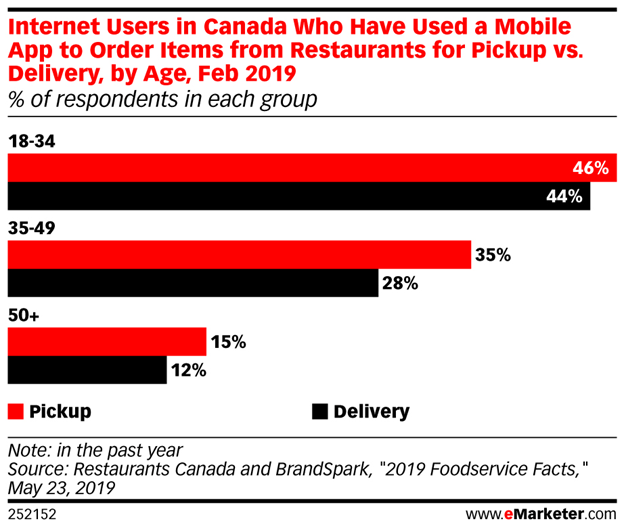
The food delivery services platforms have helped businesses cater towards the tech savvy Millennials and Gen Z customers. According to insights drawn by eMarketer based on data from Restaurants Canada and BrandSpark, 44% of survey respondents between ages 18 and 34 who are internet users in Canada have used a mobile app to order deliveries from restaurants, which is the highest in comparison to older age groups. Furthermore, based on findings from eMarketer, the data from Restaurants Canada and BrandSpark suggests that 23% of survey respondents between ages 18 and 34 used third-party apps, such as Uber Eats, SkipTheDishes and DoorDash at least once a month – this is much higher in comparison to ages 50 and older, which is 8%. It is worthwhile for restaurants to explore partnerships with third-party apps, as Millennials and Gen Z are on the raise of dominating the workforce and would increasingly have more disposable income, as student loans and mortgages are being paid off.
My research is focused on three prominent online food delivery services platforms offered in London, Ontario, Canada. Specifically, I have conducted my analysis on DoorDash, SkipTheDishes, and UberEats. To compete on price, the platforms would need to gain network effects locally to achieve economies of scale. When it comes to choosing an app, the brand of the platform does not matter; if the same meal is offered across all platforms (i.e. no product differentiation), then consumers would be most concerned about getting the food at the lowest cost with a reliable courier. I was interested to find out the price differences among the platforms. I chose 10 restaurants that used all three platforms to compare prices. Next, I selected small size orders with a range of $8.29 to $11.39 subtotals. Subsequently, to increase the orders to medium sizes, I doubled the small size orders, making a range of $16.58 to $22.78 subtotals. Then, I calculated the price per meal. (Disclaimer: the price estimates may vary based on customer’s location, restaurant agreement, and demand. The prices do not factor into tip for the courier.) Across the three platforms, it appears that SkipTheDishes have the lowest prices in most instances. SkipTheDishes have the lowest price per unit in nine out ten instances for small size orders, while it has the lowest price per unit in seven out ten instances for medium size orders. As for the highest price per unit, it is divided evenly between UberEats and DoorDash for both small and medium orders. Besides tax and tips, UberEats and DoorDash pricing includes small order fees, service fees, and delivery fees. Unlike UberEats and DoorDash, SkipTheDishes have the simplest pricing calculations and only charge delivery fees. Interestingly, DoorDash does not apply 13% HST on top of delivery fees, unlike UberEats and SkipTheDishes. Below is the summary table of my findings, comparing all three platforms.
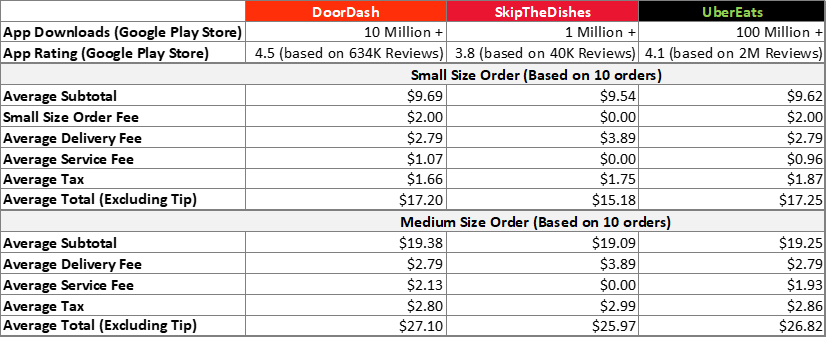
While I do not have an exhaustive list of restaurants for each platform, SkipTheDishes and UberEats seem to have more restaurants listed than DoorDash based on my searches within my location. A major decision criterion for me is pricing when it comes to food delivery services; then, the variety of restaurants would be another decision criterion. Therefore, if you don’t have time to check prices across all the platforms for every order, my recommendation is to choose SkipTheDishes first, UberEats second, and DoorDash last.
 Strategy in the Age of Decentralization