What is the issue with the waste value chain and who pays for treating waste?
We’ve all been witnesses of the visual damage that waste creates to our environment when not properly disposed of, but when waste is out of our sight, we tend to believe it is someone else’s problem. Little do we realize of the adverse effects on human health, climate and environment. Sadly, ineffective waste management often affects developing countries that either don’t yet have the infrastructure required to create different streams of waste processing, or worse are the receiver of waste that was not treated in developing countries. As the most discussed example, in 2018 China was collecting 95% of the plastics of the EU and 70% of the US’s waste up until it banned the import of plastic waste, shifting a lot of this waste down to neighbouring south/south-east Asian countries[1].

One only needs to have a glimpse at the complex network required to process waste in middle income countries to understand why waste management is an issue. An ineffectiveness of transparency and accountability throughout the value chain players creates a mismatch of the supply and demand of the trash that needs to be processed. The number of intermediaries and channels also creates a one-way stream, wherein if trash was unproperly sorted and ended up in the wrong stream it would be extremely costly and time consuming to re-allocate them for processing. As a result, it is often a lesser cost alternative to dump waste that could have been re-purposed.

In Canada the solid waste disposal per capita in 2016 was 668kg with about 20% of it being diverted from going to the landfill[3]. This number remains low and shows an opportunity for improvement. Waste management has also been a growing cost for local government in Canada, totalling $3.7B in 2016[4].
Who has the most influence on the waste reduction?
To tackle this issue in line with the United Nations Sustainable Development Goals (SDG) to substantially reduce waste generation through prevention, reduction, recycling and reuse[5], the idea of direct consumers and producer payer or actors of waste reduction has to be explored. This would incentivize behaviour change in waste reduction by having those that consume the most pay, or be rewarded for better recycling, thus addressing the issue of accountability. Ultimately funds need to flow to recyclers so that they have the economic means to perform the required R&D and technology upgrade needed to become more efficient. It is true that government may raise these required funds through taxes to gain a large pool of funds but the presence of this intermediary also signifies loss in efficient distribution of funds through delays and subjectivity in decision making. In addition, consumers and producer’s sentiment about the tax increase will be perceived as unfair.
Blockchain as a solution?
An original thought is that of using Blockchain paired with RFID/QR codes on trash bags and pieces of recycling, enabling the visibility and tracking feature of objects meant for recycling. Waste could thus be traced back more precisely to who generated it, and a direct transfer of funds could happen between the manufacturer/consumers onto the recyclers. Likewise, cryptocurrency can be used to reward those that proper dispose of their waste through the issuance of token. Having all stakeholders of the waste management chain on the same blockchain network would create this platform for waste management, adding value to the players both in the pre and post consumption of any good.
Where do these solutions exist in the marketplace?
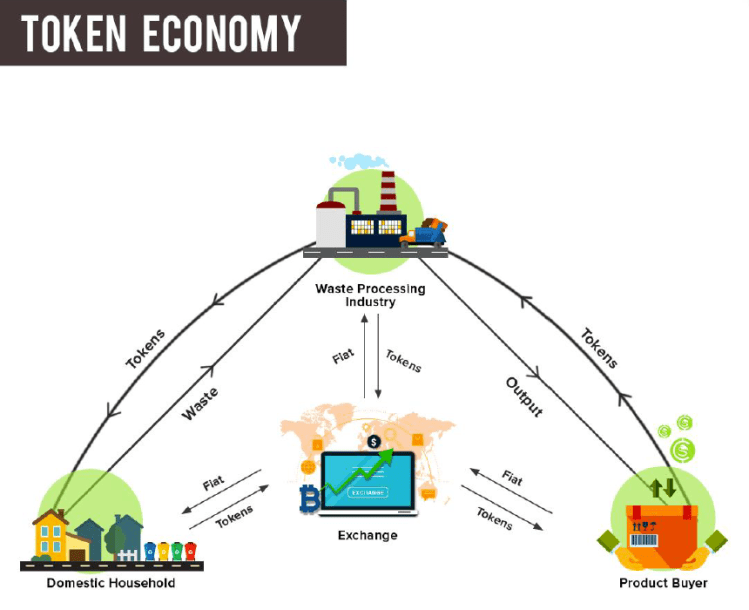
The example of Swachhcoin an Indian based non-profit organization that aims to develop a platform that rewards household waste contributors for responsibly disposing their waste. Its users are then provided with coins that they can convert into products of higher economic value. Users also have the freedom to resell these coins into an exchange marketplace or transfer these coins into a Fiat currency. Below is an illustration of how this token economy works for Swachhcoin[6]. The ICO was released in August 2018 and raised $11M USD[7].
Another example is that of AREP, a subsidiary of the French railway system (SCNF) that uses blockchain to allow more visibility in its waste management. In this case each railway station bin is a block connected via Bluetooth to the cloud to track quantities of waste in them. Station managers can then use this data to decide when to collect waste and optimize sorting throughout five different streams[8].
One last example is that of Plastic Bank a for profit organization founded in Vancouver, which has the mission of reducing the amount of plastic waste in the environment along with poverty by directly enabling consumers to become actors in waste collection. By bringing in plastic waste to a physical location, consumers are provided with a blockchain based token. Plastic bank then resales this plastic back to industry for recycling. To date the organization has diverted 8.5M kg from ending up in the ocean[9].
What are the limitations that need to be tackled?
Despite the examples shared it may come as no surprise that much remains to be done to reduce waste. Addressing this issue will require further efforts beyond the use of technology, such as an increased consumer recognition of the issue and a conscious desire to act, this may come through more education. Further there needs to be a cohesive integration of government bodies and data across jurisdiction (Federal, Provincial and Municipal) to address the waste management issue, currently this remains the responsibility of municipal bodies. Lastly in the wider adoption of blockchain technology to increase the visibility of waste and leading to those that pollute the most pay more; one needs to ask whether we as a consumer are ready to pay or change the way we consume and throw away our trash.
[1] https://e360.yale.edu/features/piling-up-how-chinas-ban-on-importing-waste-has-stalled-global-recycling
[2] https://www.oecd-ilibrary.org/sites/9789264256385-9-en/index.html?itemId=/content/component/9789264256385-9-en
[3] https://www.canada.ca/en/environment-climate-change/services/environmental-indicators/solid-waste-diversion-disposal.html
[4] https://www150.statcan.gc.ca/n1/pub/16-508-x/16-508-x2018002-eng.htm
[5] https://www.un.org/sustainabledevelopment/sustainable-consumption-production/
[7] https://icomarks.com/ico/swachhcoin
[8] https://www.arepgroup.com/news/126/data-tritus_project_using_blockchain_technology_to_serve_waste_management/
 Strategy in the Age of Decentralization