By Alisha Gautam
February 10, 2020
Barneys New York, Forever 21 and Avenue are just a few of the many retailers that filed for bankruptcy in 2019. The failures of these retail empires offer an important lesson: “Don’t rest on your laurels”. No matter how big the retailer is, failing to innovate and change as per changing consumer trends and expectations can be catastrophic to business.
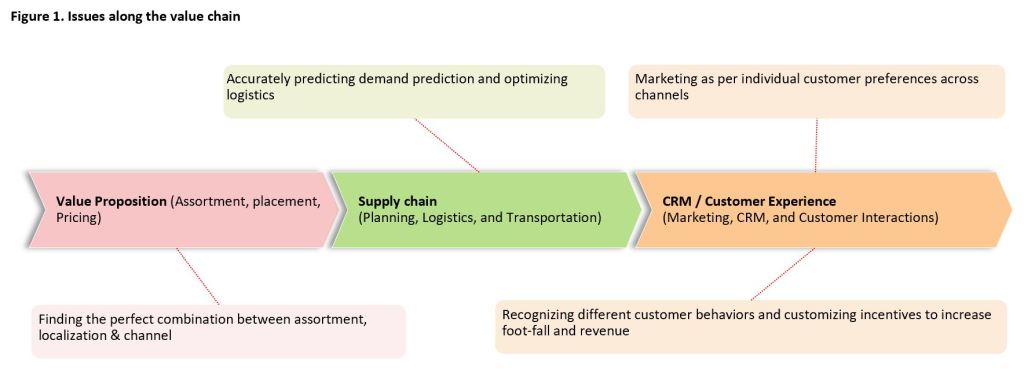
Understanding consumers, however, is not easy. In fact, retailers often struggle amidst a myriad of issues across their value chain, most stemming from their inability to accurately “understand” their customers and shoppers (Refer to Figure 1). It is surprising that even today, only 7% of retailers can accurately recognize their shoppers across multiple channels and devices. This inability of retailers to recognize and understand customers has led to issues such as high return rates (e.g. 56% of clothes shopped online are returned) and low conversion rates (< 3% customers make a purchase after visiting a site).
These issues are further exacerbated by the retailer’s narrow view of their customer. Every retailer, even the most tech-savvy ones, only knows a customer within the periphery of their limited database i.e. shopper’s purchase history in their store. They have absolutely no knowledge of their shopper’s purchase habits outside their stores. This knowledge “black hole” makes it difficult for even the top retailers to effectively innovate and recommend the most personalized products that their shoppers would be interested in. As such, a retailer’s growth is limited within its share of the customer’s wallet.
For smaller retailers or startups, the business is unforgiving and survival is difficult. Failing to innovate and change as per consumer trends can lead to lower sales and consequently, loss of new information on the customer. This loss in turn makes it difficult for the retailer to understand the “new” customer and innovate accordingly.
“Open Retailing” can bring light to this knowledge “black hole” – Refer to Figure 2.

“Open Retailing” aims to create a decentralized shopper profile that gives customers control of their own data – much like “Open Banking” but in the Retail space. One big aim of “Open Retailing” is to increase competition in the retail space by driving innovation in the quality of products and services that customers receive.
Now, let’s talk about some advances in this domain.
Shopin, a digital platform, is building a decentralized Amazon on the blockchain, using a universal shopper profile and cryptocurrency. Through Shopin’s API, retailers can access and utilize shopper-verified preferences to offer shoppers i) better product recommendations, ii) easier and more secure transactions, and iii) more valuable customer rewards using Blockchain and Artificial Intelligence technology.
So, how does this work?
Step 1: Consumer’s setup a Shopin Profile.
Step 2: Shoppers are asked to participate in a gamified onboarding experience where they are asked questions around their style preferences, sizes, etc. The more information they share with Shopin, the smarter Shopin’s A.I. powered recommendation engine becomes.
Step 3: Consumer data is automatically stored on a secure blockchain. Consumers have complete control over whether or not to share this data or which retail to share it with.
Step 4: When a shopper enters a store or a website, they can log on to their Shopin Profile. This triggers the following:
- The Shopin A.I gets temporary access to their profile and pulls inventory data
- Product recommendations are produced in real-time and displayed on the retailer site/provided to the salesperson at the store
Because all transactions will continue to take place on retailers’ sites, apps, and physical stores, individual retailers still have complete control over the user experience and can build brand equity. The only difference is that now, instead of showing the shopper 50 different pairs of skinny jeans, retailers can showcase only five pairs that are really relevant to the customer. Tailored recommendation adds value for the customer and retailers benefit from higher sales conversions and faster store throughputs.
Step 5: In return for the data, retailers also provide shoppers incentives and rewards in the form of Shopin tokens. These token can be exchanged for merchandise at participating retailers, thus creating a stronger loyalty loop in the retail ecosystem.
Shopin’s platform is currently at a nascent stage; however, “Open Retailing” if accomplished at a larger scale has the potential to not just change the nature of value creation and capture in the retail space, but redefine value itself.
For retailers and marketers (of all scales and sizes) this could mean access to accurate shopper-verified preferences data, proper recognition of shoppers across all channels, increased customer engagement, lower returns, higher conversions/sales, and more brand equity. Further, because consumer data is on the blockchain, retailers are free from risks associated with data hacks. Specifically, for smaller retailers, access to wholistic shopper data could increase chances of success and/or potential to “capture value”. For larger retailers, this could mean an opportunity to “create value” far beyond their existing share of the customers’ wallet.
For consumers and shoppers, the most apparent benefit is the “redefinition of value” via increased personalization and convenience. Personalization can come in the form of a more tailored shopping experience across channels as well as custom discounts as per personal spending habits. Convenience can come in the form of lower effort and time savings.
In order to fully realize the benefits of Open Retailing, a shared effort (from consumers, retailers and digital platforms) is required. This is challenging as while retailers would want access to each other’s data, they are hesitant in revealing their own. Retail giants are especially reluctant to hand over their precious consumer purchase data as they fear that doing so will cause them to lose their competitive advantage.
Despite these challenges, there is no denying that change is inevitable as customers and increasingly seeking this change. According to Martech Today, 91% consumers want to either have more control or block companies from using their personal data. 73% consumers are however willing to share data when brands are transparent (Accenture).
Retail is ruled by customer choices. As such, like it or not, post Open Banking, Open Retailing is coming your way. The choice is yours: amidst constant failure stories do you still want to rest on your laurels?
References:
https:// http://www.bigcommerce.com/blog/omni-channel-retail/#developing-your-omni-channel-strategy
https:// http://www.salecycle.com/blog/featured/ecommerce-returns-2018-stats-trends/
https://www.crunchbase.com/organization/shopin#section-overview
https://martechtoday.com/consumers-say-they-want-much-more-control-over-their-personal-data-226815
 Strategy in the Age of Decentralization