
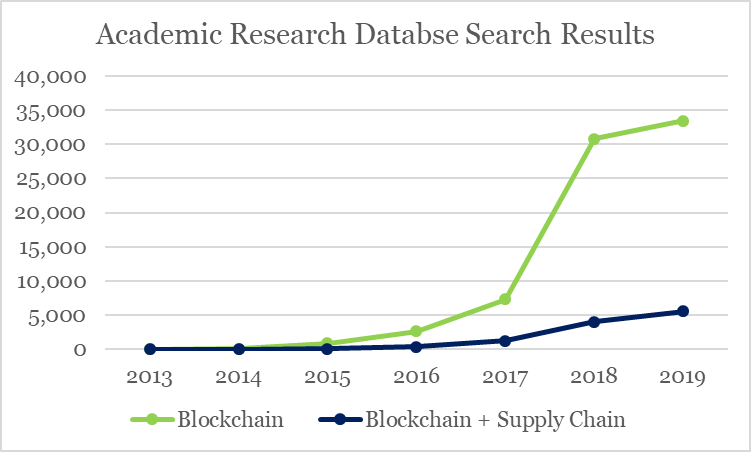
Let’s address the elephant in the room. Blockchain technology has gained popularity over the past 10-15 years especially after Satoshi Nakamoto’s paper in 2008 on Bitcoin. Yet, when it comes to implementations of the blockchain in supply chains, there has been limited success stories beyond rare proof of concept initiatives by major industry players such as Wal-Mart. The purpose of this article is to summarize what we know about how blockchain technology can provide supply chain benefits, but more importantly diagnose the reasons why its adoption has not taken off. From an academic standpoint, although we are still seeing increased popularity of ‘blockchain’ themed journals and articles, the growth has significantly dropped (see figure 1 below). In May 2019, Gartner predicted that by 2023, 90% of blockchain-based supply chain initiatives will suffer “blockchain fatigue”. Why? fragmented blockchain market and unrealistic expectations.
The possibilities are endless you say?
Before we get too far into the weeds, let’s go over some of the basics. The global logistics industry, valued at over 6 Trillian dollars, is a dynamic and complex sector. Logistics itself represents the coordination of people, information, goods and the storage of those goods from origin to destination. Some of the biggest challenges facing the logistics industry are low adoption of standards, low accuracy and redundancy of data, poor shipment visibility, reliance on paperwork, price manipulation, and so on.
With increasing competition and demand from consumers for faster deliveries, emergence of omni-channel, and global sourcing, the modern supply chain is more dynamic than ever before. Through a distributed and accessible ledger, organizations can tap into greater transparency and accountability between suppliers, leverage smart contracts for automated and immediate transaction settlements, develop a tamper proof ledger of shipment events, reduce human error, and even cut down the occurrence of counterfeit goods. The chart below categorizes the most popular blockchain benefits by the four primary supply chain areas as well as complexity and impact.
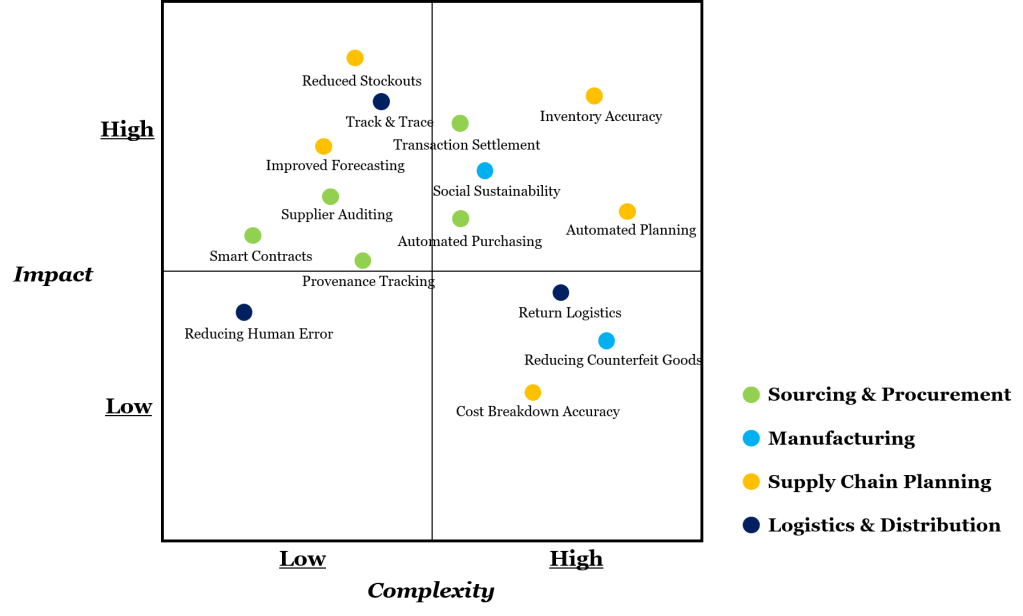
It’s important to understand that the underlying innovation driving these benefits for supply chains leverages existing technical competencies while combining it with new business models, making these innovations by definition, disruptive.
Where are we today?
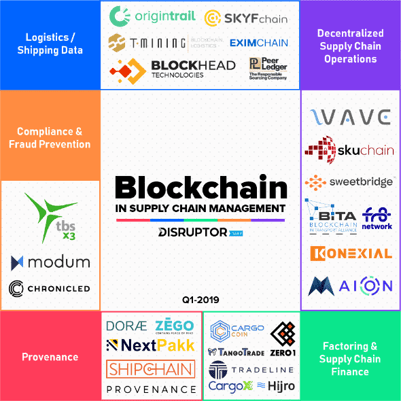
Three main trends have emerged in this space over the past few years. First, start-ups are spread wide and thin, trying to raise funding and gain visibility. In 2018, Disruptor Daily published an article listing 28 start-ups that aim to transform supply chain management using blockchain.
The second emerging trend is initiatives by major players such as Wal-Mart and IBM that are making headlines for their efforts in capturing value in the space. IBM’s TradeLens which was developed as a JV with Maersk promises to enable greater collaboration, streamline inventory management, and promote more secure exchange of information.
What both of these trends have in common is the emergence of a semi-private blockchain network. In other words, they leverage the blockchain technology as a “shared database” among only the supply chain partners that choose to implement the technology. According to the US DOT, there are over 700,000 motor carrier companies with 91% operating 6 or fewer trucks. With this level of fragmentation, what we need is shared standards and platform, not a specific application with revenues funneling through one provider or organization. This leads us to the last emerging trend, the introduction of consortia’s such as BiTA (Blockchain in Transport Alliance) showing a lot of promise to drive standards and blockchain adoption in the logistics industry. With over 500 members in over 25 countries, BiTA forecasts maturity in blockchain tech by 2026.
The goal is to drive down the cost of implementation, thereby creating value for organizations by reducing the cost of overall logistics activities. The value created by the supply chain partners can then be captured by the consumers, increasing the consumer surplus.
So what’s the hold up?
From a technology standpoint, there are a number of reasons holding us back from full adoption. Although we may have all the building blocks necessary to enable benefits, what we are missing is the link between the smart devices that capture the data (IoT, RFID, LoRa) to the platform that enables the sharing of the data in a decentralized way. Most organizations currently rely on a major ERP provider for the coordination of operations activities internally with the major point of integration among external partners being EDI, a technology from the 70’s. The second issue is the ecosystem. A lot of the activities still in this space are developing these closed private ecosystems that benefit only the key players that are directly involved in their supply chain. Another key aspect is data immutability. The immutable nature of the blockchain is touted as it’s main feature. But not having a CTRL Z button is not a feature many corporations are interested in since there is always mistakes or modifications that are needed to be made. That’s why they use a semi-private blockchain so they can roll the data back and modify it at will. This takes the point of blockchain away, since now they’re operating a distributed database, and these have been around forever. The current state of blockchain in the industry is analogous to the intranet, which provided limited access to a closed network. What we need is the internet, an ecosystem of supply chain partners. Finally, data authenticity and transparency are major areas of concern. The same problems that applied to RFIDs, also apply here. Just because you put the data on the blockchain instead of a centralized database, doesn’t mean the data is true or accurate. You can still misrepresent, or put faulty data in the blockchain. Putting it on the blockchain just makes it immutable.
From a business standpoint, the biggest reason we are not seeing more companies more invested in this space is the misalignment of incentives between the shareholders and company management. With shareholder value on top of mind, a lot of major players in this space are still in the POC phase while trying to understand the tangible ROI in a project that is enabled by blockchain. We need to understand that with any new innovation (new business model or technology), the direct link to the bottom line may not be realized within the first few years. In order to speed up innovation in this space, company executives need to align the performance measurements with the incentive system. The other, and equally important, major issue creeping up the industry is the scarcity of talent that is capable of taking advantage of emerging technologies to drive value for organizations.
 Strategy in the Age of Decentralization