Background
Healthcare has historically been a centralized industry, particularly in single-payer countries like Canada. Defined within the Canada Health Act is the rule of public administration, which has led most provinces to have a central decision-making authority, such as the Ontario Ministry of Health and Long-term Care (MOHLTC). Furthermore, from a patient perspective, healthcare is highly centralized and not patient-centric. In order to receive care, a patient must go to a hospital or clinic, with relatively few options of community or home-based alternatives. If a patient wanted access to their own medical records, they historically had to physically go to a Health Records department of a hospital and request access. At that point, the hospital had the right to redact any information that they did not want the patient to see. Then, only after paying a photocopy fee, would they be able to receive a copy of their own records. It is a similar process for sharing data with a third-party, including an insurer or different hospital.
Early Decentralization
An early adopter of decentralization of healthcare is 23andMe. Co-founder and CEO Anne Wojcicki felt passionate that HMOs, hospitals, and doctors were all making decisions in a centralized manner, without allowing patients to be more actively involved in their own care. She was also concerned that in a for-profit healthcare system like America, incentives between the industry and patients were not always aligned. Her goal therefore was to create a direct-to-consumer product that would allow patients to know their genetic information and risks, without the need for a middle-man like a physician.
Within Canada, there has been decentralization of health data by giving patients the opportunity to access their medical records without redaction, thereby losing some control and authority. As an example, Dynacare Labs provides a subscription platform to end-users offering access and storage of all labwork. MyChart is also a new infrastructure providing patients with access to their clinical records and is being rolled out across Ontario including London’s Regional Cancer Program and Breast Care Program. While noble to decentralize access to information, all of these companies have the same, significant flaws.
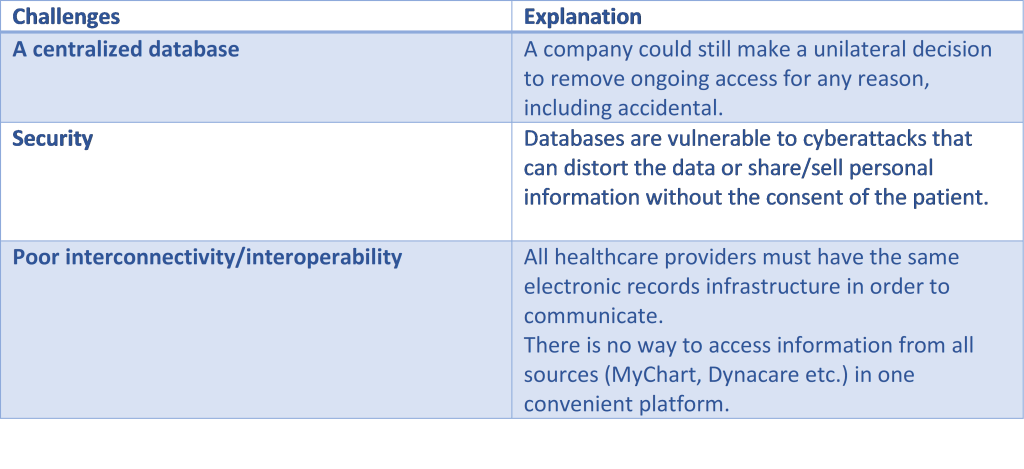
Ontario continues to be focussed on developing an integrated, connected healthcare ecosystem. An ideal system would provide value for both government and patients while simultaneously addressing all of the issues with current electronic medical records.
The Solution – Blockchain Electronic Medical Records
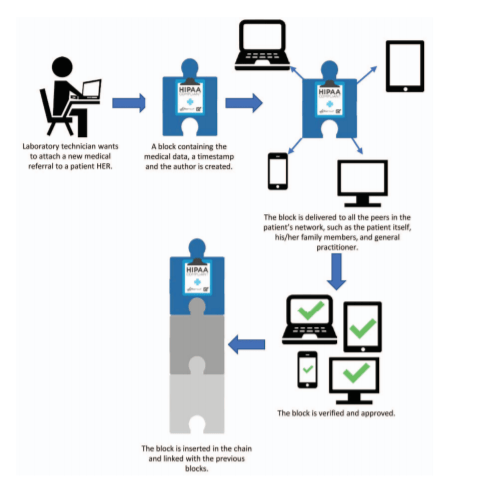
A blockchain backed EMR allows for patient’s medical information to be stored within a block on a distributed ledger. The information would be updated and accessible by anyone with permission to access it. For example, a doctor, nurse, or personal support worker, each working for a different institution with its own IT infrastructure, could update the information on the blockchain but without needing to conform to one standardized EMR system. The blockchain would prohibit anyone from tampering with data and is secure in the form of anonymized data. Most importantly, a patient can access their own medical record at any point, without requiring permission from a healthcare provider or institution. While blockchain EMR would address all of the current concerns with EMR, it is important to note than only a few start-ups from around the world are currently offering this product.
Barriers to Implementation
One concern is that storing large amounts of encrypted data, such as imaging results (MRI, X-ray), is too burdensome for blockchain. A node on a smartphone or laptop would never be able to validate that type of information. There are possible solutions to this problem. Firstly, there could be an option for a computer to be a “light node” such that they only store block headers, while the full nodes process and store every block in the blockchain. Secondly, large files could be stored “off-chain”, for instance held within a hospital storage system, with access via a health metadata blockchain.
Interestingly, two health-tech start-ups appear to have solved the data size problem. DNAtix and Zenome have both successfully transferred large amounts of genetic data using blockchain. For both companies, their goal was to decentralize databases like 23andMe and give power, control and ownership to the individual who provided their DNA.
Value for Ontarians
A blockchain-backed EMR creates the most value for the patients and government. Patients can benefit from the convenience of accessing their own medical records and sharing them among different healthcare providers. Both patients and governments benefit from a reduction in redundant or duplicative testing as there is improved sharing between providers. By reducing unnecessary tests, the government experiences a reduction in overall costs. Additionally, there is value in quality for patients and cost-savings for governments by reducing medical errors with a blockchain-backed EMR. As an example, with effective sharing of medical records, a patient may be less likely to receive a medication for which they have an allergy or adverse reaction.
A blockchain-backed EMR decentralizes information by sharing it across a decentralized ledger (rather than one hospital storing the healthcare data), but it also decentralizes power by giving more information to the end-user in a much more convenient manner. Despite that, blockchain record keeping in Ontario is likely to be a radical innovation.
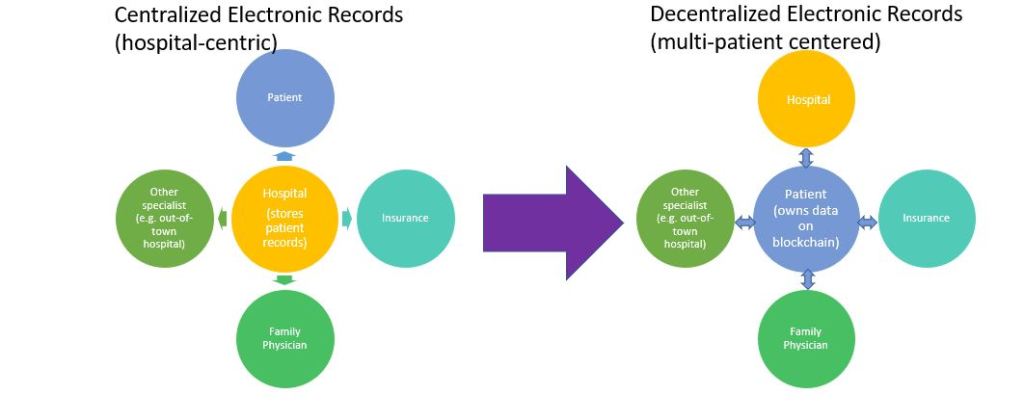
A centralized administrative body, like MOHLTC, can invest in research and development to create their own blockchain EMR, or they can work with current start-ups including Coral Health. While blockchain EMR does improve ease of access, it is unlikely to replace the intermediary of healthcare providers. Additionally, the payment model of hospitals and individual physicians will likely not change.
Blockchain-backed EMR may, however, further decentralize the industry in terms of providing ease of access to telemedicine or home-visits. If any physician had remote access to a patient’s entire medical history, then there would be less incentive for that physician to work within a hospital, making either telemedicine or home-visits more feasible. There are multiple proven benefits of decentralized, patient-centric care including comfort for patient, reduced costs, and improved accessibility for rural patients. Furthermore, the use of personal support workers to do home visits for medically unwell patients is currently underutilized, in part because of poor integration with other medical records. By using blockchain-backed EMR, healthcare would improve and be able to provide the right care to the right patient at the right time, and at the right location. Now that would be revolutionary in healthcare.
 Strategy in the Age of Decentralization