
A “shared care record” that optimizes the health of individuals and populations worldwide: such is the vision of interoperability.
Interoperability refers to the architecture or standards making it easier for various healthcare providers to exchange patient information across various EHR (electronic health records) systems. As Dr. Farzad Mostashari, former Health I.T. National Coordinator at the U.S. Department of Health and Human Services, puts it: the “information follows the patient regardless of geographic, organizational, or vendor boundaries.”
Interoperability offers the promise of effective care coordination, reduced healthcare costs, and much-improved quality of care. With the right data available to the right HCP (healthcare professional) at the right time, efficient workflows are created; patient safety is enhanced; the duplication of various tests and prescriptions is reduced; the accuracy of medication information and overall medical history is improved.
As with the goals outlined by Mostashari’s previous office—imagine a health system where the patient is truly at the center of care; providers “have a seamless ability to securely access and use health information from different sources”; one’s health information portrays “a longitudinal picture of health”; and “public health agencies and researchers rapidly learn, develop, and deliver cutting-edge treatments.”
A future with complete, seamless interoperability looks very compelling. However, interoperability remains to be one of the greatest challenges of healthcare systems globally, including Canada’s. This may be attributed to the lack of collaboration across various players, development costs, poor data quality, lack of agreement on standards, and privacy concerns.
Fortunately, a number of healthcare start-ups have risen to the challenge—all powered by blockchain technology.
Promising Start-Ups
Among this league of up-and-coming start-ups are U.S.-based Patientory, Coral Health, and SimplyVital Health (SVH)—founded by Chrissa McFarlane, Andy Park, and Katherine Kuzmeskas and Lucas Hendren, respectively, between 2015 and 2018. With decentralization at the core of their business model, technology, and raison d’être—all three bring the power over one’s health information back to the patient. All enable patients to instantly access their own health data, and share it with whomever they want. The patient is an empowered agent, the primary intermediary for sending and receiving his or her own health information.
Further, the healthcare system functions not only to efficiently deliver personalized care and optimal health outcomes, it also allows patients to gain from their personal data: SVH promises users the ability to sell privileged medical data to research institutions; Patientory promotes letting users make anonymous data available to pharmaceuticals and insurance companies for R&D and business development, in exchange of drug coupons or discounts on services.
The ground-breaking potential of these start-ups lies in their ability to serve as transaction platforms: online matchmakers for the healthcare system’s mostly-fragmented players. Through Patientory’s mobile app, users gain access to a larger community from whom they can learn more about their condition. The app also enables physicians to send or receive referrals online, whereas Coral Health’s app lets users easily search healthcare providers. Similarly, SVH’s Health Nexus product aims to become the “de facto marketplace and matchmaking service for individuals, healthcare providers, and researchers” (the company’s other product, ConnectingCare, brings together providers from various medical institutions onto the same platform, where each can view the same data for shared patients).
With all patient data stored in a central depository, gone are the days of information silos and gaps, or data sets offered in disparate formats. Care is streamlined, value is created for various stakeholders.
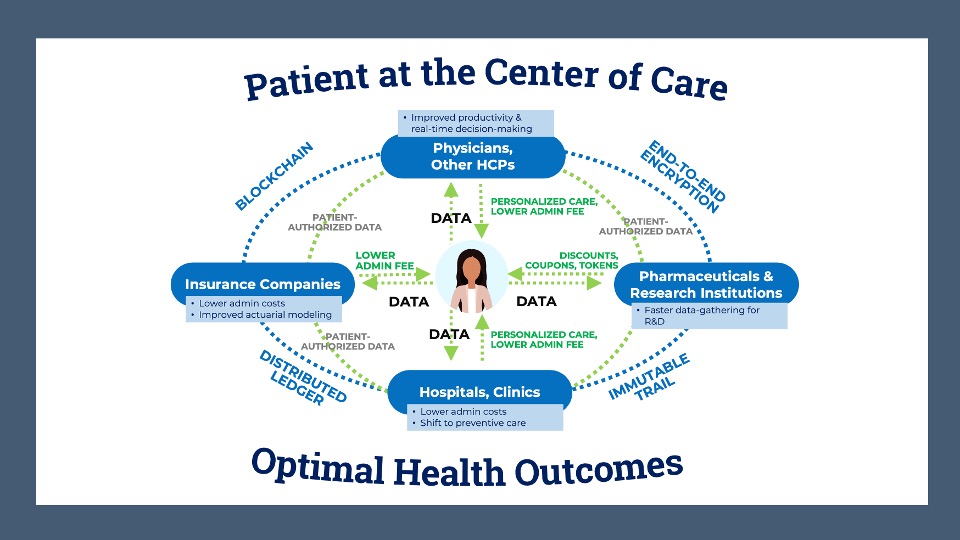
By having access to patients’ entire medical history, physicians save time on diagnosis, and can better provide personalized treatment. Also, process automation helps healthcare organizations reduce processing time and administrative costs (within its first four months, Health Nexus enabled providers to save an average of $6,600 per patient). The hope is for these savings to be transferred to patients, who stand to enjoy lower healthcare costs. Even researchers stand to benefit from patients’ increased willingness to share medical data—facilitating drug discovery, public health research, and medical breakthroughs.
Such is the promise of healthcare in today’s age of decentralization. As the aforementioned start-ups propose, no technology could meet the demands of such a decentralized way of operating more adequately than blockchain: a distributed ledger that records transactions between parties in a verifiable and permanent way.
Why Blockchain
A decentralized technology, blockchain serves the demands of interoperability.
First, blockchain alleviates users’ top concern: data security. Using end-to-end encryption via cryptographic hashing, patients’ information are protected from fraud and hacking—fostering greater levels of trust and confidence among stakeholders.
Second, blockchain enables participants to read and update the same database; consequently, different providers coordinate patient care, and find no need to repeat the same tests. Parties can refer to an immutable audit trail, where all nodes reach consensus on the order in which events occurred.
Third, inserting patient information into a distributed ledger makes data permanently accessible, not dependent on any specific entity (e.g., hospital) to continue hosting that data.
Interestingly, blockchain enables health start-ups to utilize their own cryptocurrencies. Patientory plans to launch the PTOY, which allows users to buy additional storage for their medical information. Coral Health features Coral Health Token, which aims to incentivize information-sharing among patients and HCPs. Patients will be able to use the token to unlock additional features (e.g., targeted health tips); pharmaceutical and insurance firms can spend it to obtain patient-authorized data for operations and R&D. Last year, SVH sold its Health Cash Tokens in a crowdfunding round, but refunded most investors given a cease-and-desist order due to its failure to register with the Security and Exchange Commission.
Relevance and Scalability
The featured start-ups are poised to address some of today’s most significant trends in healthcare. By streamlining care, they can ease physician burnout and decreased productivity (Deloitte reports that for every 1 hour spent with patients, nearly 2 hours are spent on documentation). Moreover, their value proposition appeals to today’s consumers, who believe in owning their personal health record. No longer passive, these consumers demand transparency, convenience, and personalized services. Most importantly, they want affordable care.
Given such real-world relevance, the factors impeding these blockchain-enabled ventures’ scalability must progressively be addressed. Blockchain adoption represents a major cultural shift in healthcare, whose players still largely rely on paperwork. In fact, the very nature of today’s healthcare industry poses adoption barriers: fragmented and distributed (many services exist due to administrative inefficiencies; wherefore, improving efficiencies threatens some providers’ revenue-generating capability), highly-regulated, and risk-averse (HCPs are trained to be “thorough and skeptical by nature”). Furthermore, healthcare data is extremely sensitive data, with life-and-death repercussions.
To allay resistance, change management, widespread education, and technical reskilling are vital. Executed well, these efforts can onboard more members onto the network: a critical source of competitive advantage for any platform venture.
Strategic Imperatives
Blockchain, like the Internet, is what Marco Iansiti and Karim Lakhani describe as a “foundational technology,” not simply a disruptive technology that undermines traditional business models through lower-cost solutions. Because it can build a new foundation for our economic and social systems (and inevitably threaten current models), blockchain will take years to fully realize. Thus, to continually build trust in the technology, proponents of blockchain adoption in healthcare must be assiduous and vigilant about enabling and documenting successful, credibility-building proof cases.
Realizing interoperability through blockchain requires new business models and technical competencies. Hence, borrowing from Anand and Barsoux’s transformation sandwich metaphor, the innovation journey must clearly demonstrate value creation and entail leadership development. In between these two imperatives, the transformation must be driven by a collective commitment to improving patients’ and other end-users’ experience, relentless R&D, and most of all, inter-stakeholder collaboration and dialogue. Ultimately, the start-up that most effectively leverages these imperatives in the shortest time possible stands to capture the greatest value.
 Strategy in the Age of Decentralization