Assessing multi-level value creation and performance in humanitarian aid
In the current hyper-globalized landscape, frontier technologies like blockchain can promise a wealth of material progress. But it can be challenging to balance considerations of economic value with those of a more human nature. Fortunately, the United Nations’ vast portfolio of blockchain efforts offers just the opportunity.
A Question of Value
In a 2017 Twitter post, 23-year-old Ethereum co-founder and university dropout, Vitalik Buterin, questioned whether crypto had earned its gains based on what it had contributed to society. “So total cryptocoin market cap just hit $.5T today,” he said, “but have we earned it?”. So it didn’t come as a surprise when he elected to work with the United Nations Children’s Fund, teaching youth in Cape Town how to solve global issues using blockchain. Once a refractory, rebellious force- tirelessly working towards alternative norms in uncharted and contested digital territory- he was now helping a massive intergovernmental organization, whose primary function was to formulate political, economic, and legal frameworks for control.
In a December 2019 statement to Forbes, UN secretary-general António Guterres suggested that blockchain technology had generated some $50B in revenue for the organization annually. “For the UN to deliver better on our mandate in the digital age,” he called, “we need to embrace technologies like blockchain that can help accelerate the achievement of Sustainable Development Goals”. But to the general public, blockchain itself is still an unfamiliar concept. This is partially due to the fact that it’s based on a set of principles rather than hard rules, so in reality, it isn’t just ‘one thing’. So how do we define blockchain?
Blockchain in Short
In short, blockchain is a distributed digital database. The Centre of International Governance Innovation, a non-partisan think tank, offers an efficient explanation. To summarize, ‘Node A’ requests to record information on a special blockchain network. For this to happen, ‘Node B’ must first solve a complex mathematical puzzle. Node B then requests solution verification from all computers on the network. If verified, the information is written to a ‘block’, and the block is then linked to a ‘chain’ of other blocks and distributed across the network. The protocol won’t allow writing that conflicts with a previous block, nor will it allow revisions to earlier blocks other than by an append. Though there’s no central party, consensus exists on the network, making it ‘decentralized’. This can serve as the main mode for executing various types of secure transactions across e-government, smart contracts, identification, supply chain, data storage, financial services, and more.
Heeding the Call
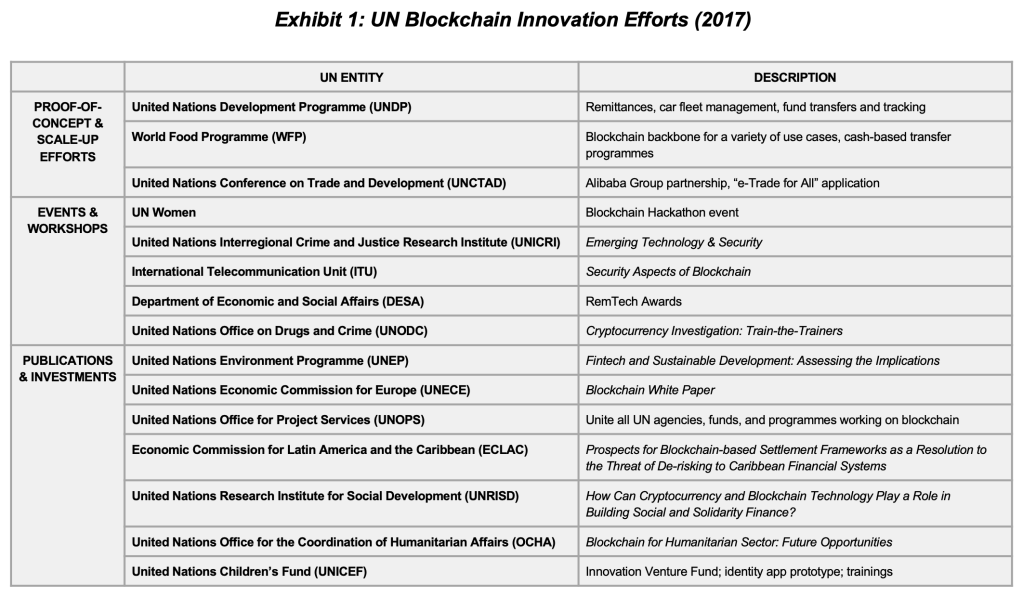
A 2017 internal review showed that the UN’s work around blockchain had already been a priority for several years, with no less than fifteen UN entities carrying out initiatives across the organization (Exhibit 1). The UN has shown rapid and significant progress to date (Exhibit 2). Many of their development projects represent architectural innovations, characterized by the need for new business models and technical competencies, effectively managed by bringing architectural knowledge to the top, building inclusive identity, and retaining control of end user experiences.



UN and Partner Value Creation
As part of the 2030 Agenda, the UN identified SDG 17 as “Partnerships for the Goals”. Guterres remarked, “the UN has unparalleled capacity to convene and mobilize… building meaningful partnerships with the widest array of Governments, regional organizations, international financial institutions, civil society organizations, academia and the private sector”. Partners can capture value by accessing this network. For contributors like Buterin, for example, this could mean access to the largest network of cross-sector partners in the world, enabling his ‘alternative norms’ to diffuse broadly throughout UN member states. What’s more, the UN prioritizes impact by actively measuring, quantifying, and reviewing its progress towards each of the individual SDGs.
Value creation in humanitarian aid at the organizational level can typically be difficult to measure. The Value for Money (VFM) model is a popular approach. This encompasses the ‘4 E’s’- economy (input cost reduction), efficiency (process benchmarking), effectiveness (budget allocation for impact), and equity (community vulnerability status improvement). A recent annual report from the UN Global Innovation Centre loosely suggests that it may very well be using metrics like these, but it’s unclear based on information available to the public.
These innovation efforts can be likened to those of corporate research and development. But measuring value creation and performance in research and development can also be a challenge. One McKinsey article suggests that the best innovation performance metrics are ‘R&D-to-products’ and ‘new-products-to-margin’. The UN may be able to adapt models like these to include VFM inputs, as well as others suggested by the World Economic Forum, such as user innovation, risk management, social media listening, and trajectory mapping. “If government policy is to be informed,” says the WEF, “… [case studies] have to comply with formal research method protocols to ensure they are relevant, accurate and can be compared”.
Value Creation for Aid Recipients
Some 70.8M forcibly displaced people exist worldwide, of whom over 20M are refugees that spend an average of 17 years in refugee camps. Aid organizations can utilize blockchain for identity verification, funds distribution, and electronic work permits- three very important enablers of survival. One such project is the UN’s Building Blocks, which uses a private blockchain to identify refugees via biometric iris scanning and to distribute funds.
Governance and the Future
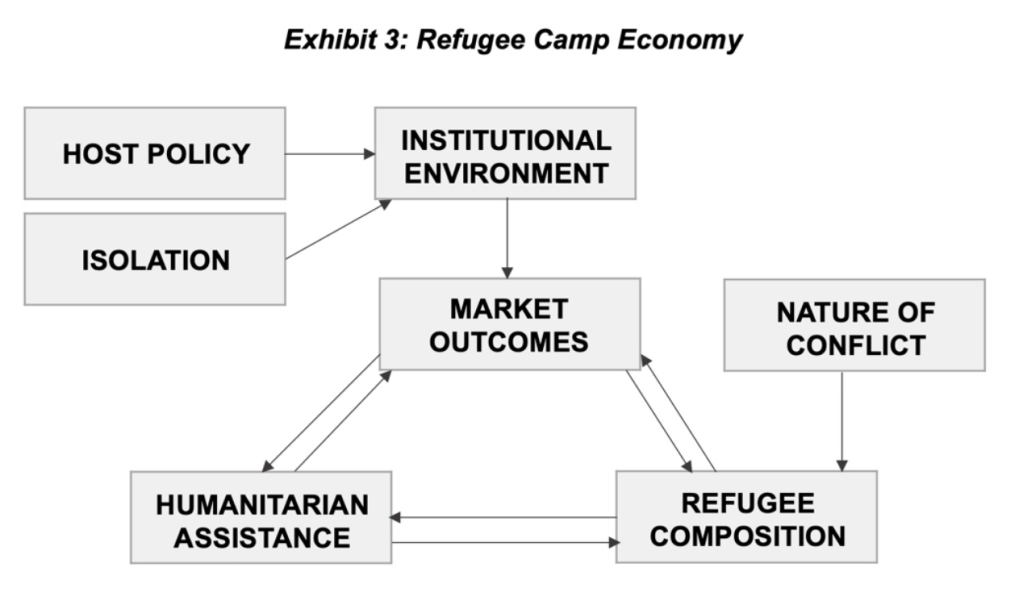
While these efforts have shown promise, aid agencies have been criticized for their paternalistic approach. The strange economics of refugee camps (Exhibit 3) has emphasized the need to focus on refugee contributions to both host country and informal economies, the treatment of skilled workers, entrepreneurship and autonomy, market opening, and the impact of religious institutions.
Concerning governance, policy around surveillance, artificial intelligence integration, blockchain interoperability, universal basic income, the circular economy, international law, and empirical analysis will prove critical. While aid organizations make headway in capacity and network building, they should also include substantial refugee input in the design of solutions. But with contributions from thinkers like Buterin, who promote alternative governance principles like those brought forth in the Declaration of the Independence of Cyberspace, we can be sure that progressive voices are being heard in the ushering of a new, decentralized era.
“Where there are real conflicts, where there are wrongs, we will identify them and address them by our means. We are forming our own Social Contract. This governance will arise according to the conditions of our world, not yours. Our world is different.” ■
 Strategy in the Age of Decentralization