Here’s a riddle for you: On Friday, you order pasta rigatoni from Luigi’s Pasta. On Saturday, you order butter chicken from Sita’s Kitchen. And on Sunday, you order the impossibly scrumptious #8 combo – Big Ben’s Explosion with cheesy fries – from Big Ben’s Burgers. However, they all come from the same kitchen – what’s going on?
These three ‘restaurants’ are all located at the same address and service a set number of dishes from what is now termed as a ‘cloud kitchen.’ According to YourStory.com, a cloud kitchen is a “phenomenon in which a small food outlet or group of food brands share kitchen space under one roof.” The caveat, however, is that cloud kitchens cater only to take-out or delivery-only customers. It is these service policies that allow cloud kitchens the flexibility to be able to offer an assortment of dishes under one roof. According to research and reports from the National Restaurant Association, off-premise sales now account for over 60% of all occasions in the foodservice business.
In this blog post, I will analyze the pros and cons of cloud kitchens, the competitive implications of their emergence, the distribution of value in the cloud kitchen industry and the main drivers for this trend.
Pros and Cons
The benefits of cloud kitchens are numerous: cloud kitchens can be versatile as noted in the example above, they can enjoy lower overhead costs, maximize efficiency with custom built kitchens, and importantly, they can access data and adapt to changing consumers tastes.
The cons, however, are also unique to this particular business model. Due to the attractiveness of this business model, cloud kitchens may enter a digitally crowded marketplace. Furthermore, reliance on third-party apps makes the kitchen beholden to the price structures and performance limitations of the third-party service. Finally, food quality and safety may be compromised in the desire to win as many orders as possible.
Competing with standalone restaurants
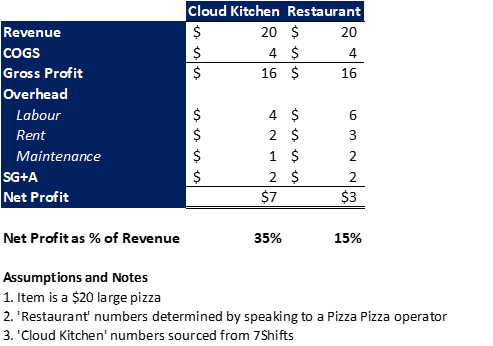
The business case for cloud kitchens is lucrative. As seen in the table below, cloud kitchens allow the operators to keep a substantially larger portion of the revenue, enabling the entities to either pass along the savings to the customers or keep a reserve for the third-party delivery apps.
Another advantage that cloud kitchens have is that they need not be located in a heavily trafficked area; cloud kitchens can conveniently locate themselves by major highways or equidistant from two hubs in order to be able to service and deliver to as many people as possible. In summary, then, cloud kitchens must find the right balance between being accessible in a large catchment area and the minimizing of delivery time required to deliver food to customers in the most far flung corners of that same area.
Keeping up with trends
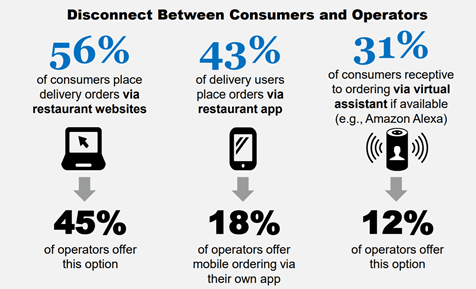
This sudden shift toward cloud kitchens is not new; in fact, trends have – for years – been pointing toward a quicker, more delivered-centric solution. For example, as highlighted in the National Restaurant Association’s report, off-premises orders are now greater than on-premises orders. However, when questioned, 29% of restaurateurs mentioned that they are lagging the industry. For example, as seen below, there is a substantive gap between the percentage of customers who use a particular method i.e. website or app and the percentage of total restaurants who currently offer or accept those technologies.
Decentralization
As shown earlier, cloud kitchens keep significantly greater revenue than do normal restaurants. This change is mainly driven from needing a smaller space in a less well-known part of town and the ability to staff employees on a mainly variable basis. However, the true beauty in the business model is the ability to service multiple potential customers at either the same or no marginal cost.
In the example that I provided at the beginning of the blog post, the restaurant offered three different cuisines. Traditionally, one restaurant is only able to service on type of cuisine – you either sell Indian, Italian, or American. In order for you to sell other cuisines, you must create a new brand, find a new location and labour, invest in machinery, and slowly start the new restaurant.
Now, however, one can sell any cuisine by procuring some ingredients and rotating them among a few best-selling dishes. The ‘restaurant’ does not need to change its name, decor, or any other identifying feature. It does not need to change its physical experience or branding, typically the most expensive parts to change of any restaurant. Thus, the marginal cost to service an incremental customer is almost exponentially lower in a cloud kitchen that it would be in the traditional model. Furthermore, the ease of access to the Internet, along with a ubiquity of third-party delivery apps and emerging technologies allows them to be picky for the service that suits them the best. The systematic decrease in operating costs means the barrier to entry for entering the food service business has decreased, and those who want to experiment without needing to sign a long-term lease or hiring may workers are able to do so relatively easily. The focus of delivering food as by a third party as fast as possible allows the cloud kitchen flexibility and efficiency in preparation of the food itself.
Conclusion
Currently, there is a push from multiple directions toward the establishment of cloud kitchens: the technology is available for operators to minimize friction and consumers are eating off-premises more than ever. The reaction to these changes is bearing out in the establishment of cloud kitchens en masse across the globe. The importance further lies in operators deeming which technological service will be critical in ensuring success; will voice assistant capability enable greater business, or do the operations of the kitchen themselves lend to more scope and potential? Either way, it is abundantly clear that changing consumer preferences will push more and more restaurants toward the cloud kitchen – the question is how will established players react, and how will upstarts work to steal market share from entrenched restaurants?
 Strategy in the Age of Decentralization