Advertising Tsunami
The Global Advertising Industry, currently at $563B annual spend[i], effects humans in a massive way – It is estimated that consumers get exposed to around 4,000 to 10,000 ads every single day[ii]! With such an overwhelming amount of exposure to ads, humans are screening which brands to engage with and which brands to ignore without even realizing it, often only choosing 100 ads per day to get past their attention wall[iii]. This has created a world where publishers, marketers, and advertisers must be incredibly laser focused on their brand strategy and messaging to succeed, while consumers are still bombarded with lots of useless poorly targeted spam. Meanwhile, a handful of centralized middlemen platforms such as Google and Facebook are becoming rich in the process while controlling the end consumers data often without them realizing it. I believe that the next major change in the Advertising Industry will be the transition to decentralized advertising networks that could create possible benefits such as immutable advertising metrics, transparent media buying and selling, better consumer targeting, better protection of personal data, and user data self-monetization[iv].
History of Advertising
The History of Advertising has undergone many drastic changes over the years such as the transition from radio to TV, or the even faster change from newspapers and TV to Internet based digital advertising and mobile based social media platforms. During these transitions there has been tremendous amounts of value created (as shown in exhibit 1), however a disproportionate amount of the value seems to always be captured by the stakeholder in the middle. For example, end consumers receive more targeted ads on digital relative to TV, and advertisers have a better idea of ROI on digital ads than TV, but during this transition we have also seen the creation of a handful of the most valuable companies to ever exist acting as the gatekeepers in between advertisers and end consumers. As well, there seems to be a misalignment of interests between the different parts of the value chain. Marketers, advertisers and publishers want better ROI, less fraud, better targeting and more insightful KPI’s. End consumers want less, more targeted ads that actually lead to a purchase and better data security and privacy. In many ways, the start and end of the value chain have aligned interests. However, the gatekeepers in the middle simply want more ads while commanding higher prices via the controlling and manipulating of end consumer data.

Decentralization of the Advertising Industry
Decentralization and leveraging open blockchain technology have the potential to shake up the global advertising industry in a big way and more evenly spread value across the value chain to the appropriate stakeholders. First, an open ledger that tracks transparent links directly to advertisements would create reliable numbers of clicks and impressions that the advertiser and ad purchaser could openly see together. This would allow them to interact without any middlemen and create more honest negotiations (Mire, Sam: Disruptor Daily)[v] Second, paying members of a given target market to interact with ads using micropayments from a decentralized currency would allow advertisers a much more affordable way to test ROI of ads in small samples before launching large campaigns. (Mire, Sam: Disruptor Daily)[vi] Third, companies such as Civic (who are using decentralized blockchain to secure personal identity data) could allow the individual more ownership over who can use their data and for what purpose. Individual consumers could then give permission for information to be transferred along a secure blockchain at a price that suits them to an advertiser, rather than a company like Facebook doing so. (Mire, Sam: Disruptor Daily)[vii] Seeing as 62% of the U.S. public[viii] are very uncomfortable with the thought of companies being able to sell personal data for advertising purposes, this has the potential to make a massive change to the global advertising industry.
Putting it all together in a Decentralized Ad Network
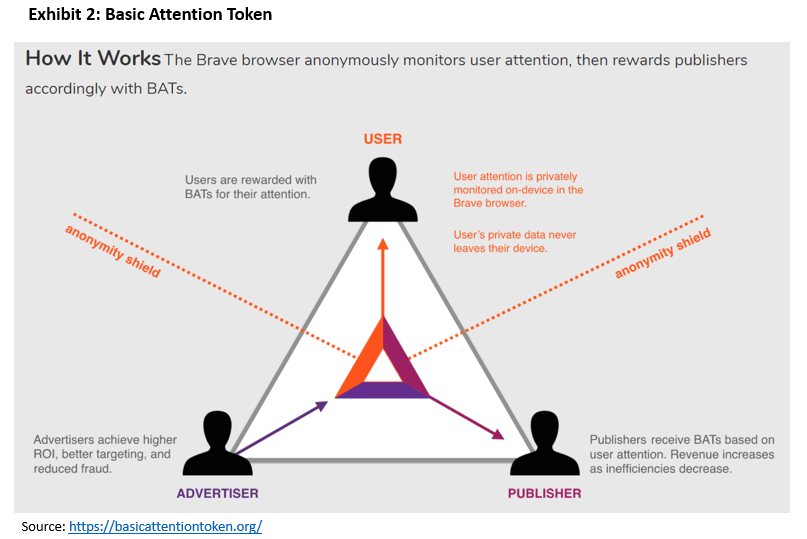
Although there are many potential benefits from decentralization in the global advertising industry, it is unclear when those benefits will be successfully taken to market. I believe that the best chance of that happening is if one company (or small collection of companies) can create a decentralized platform (or ad network) that incorporates a number of these benefits into one place. One of these decentralized ad networks which I think is worth taking a closer look into is Basic Attention Token (BAT)[ix]. As of early February 2020, BAT has a market cap of ~$509M CAD after a successful round of crowd sourced funding back in 2017[x], which means it should have enough money to continue growing its network for the foreseeable future. BAT also has a competitive advantage because it is designed to work with an open sourced privacy focused browser called Brave. At a high level, the BAT token and integrated Brave browser allows advertisers to interact directly with publishers and end consumers to get the required information without sacrificing the end consumers privacy[xi] (as expanded upon in exhibit 2)[xii]. The token can then be exchanged between publishers, advertisers and users while its utility is denominated by amount of attention (or mental engagement)[xiii]. It is also important to note that if BAT is able to scale their 3-sided platform that addresses a lot of the cost and trust issues in the current middleman dominated value chain, they could then begin to connect the platform to related industries such as E-commerce. For example, they could build pathways to Shopify merchants so consumers could track the origins of products they have purchased via ads[xiv], and merchants could deal directly with publishers using the BAT token rather than spending a fortune on Facebook ads. But that is a discussion for another day!
Final Thoughts
When we take a step back and look at the global advertising industry as a whole, it is easy to think that it is working well. The industry has changed in innovative ways a number of times over the last 20 years. The rise of Digital has created more targeted advertising options. And advertisers now have the ability to participate and publish on a more personal level with their millennial and gen Z audiences. However, a deeper look at the value chain shows a misalignment of stakeholder interests and an over saturation of meaningless adds. I believe it is now only a matter of time before decentralized ad networks rise up to restore balance to the industry!
By: Graeme Barber
[i] https://www.statista.com/topics/990/global-advertising-market/
[ii] https://www.forbes.com/sites/forbesagencycouncil/2017/08/25/finding-brand-success-in-the-digital-world/#b12ae3a626e2
[iii] https://www.redcrowmarketing.com/2015/09/10/many-ads-see-one-day/
[iv] https://www.disruptordaily.com/blockchain-use-cases-advertising/
[v] https://www.disruptordaily.com/blockchain-use-cases-advertising/
[vi] https://www.disruptordaily.com/blockchain-use-cases-advertising/
[vii] https://www.disruptordaily.com/blockchain-use-cases-advertising/
[viii] https://www.statista.com/statistics/873832/internet-users-comfortable-companies-selling-personal-data-online-ad-purposes/
[ix] https://basicattentiontoken.org/
[x] https://coinmarketcap.com/currencies/basic-attention-token/
[xi] https://www.investopedia.com/news/blockchain-unlocking-advertisers-profit-potential/
[xii] https://basicattentiontoken.org/
[xiii] https://basicattentiontoken.org/
[xiv] https://www.investopedia.com/news/blockchain-unlocking-advertisers-profit-potential/
 Strategy in the Age of Decentralization