
“One sector, however, has carried on as if technology had never been invented: the law. Lawyers’ working practices ‘have not changed much since the time of Charles Dickens’“
The Future of the Professions’[i]
What is Access to Justice:
The United Nation Sustainable Goal 16 aims for equal access to justice for all.[ii] Rule of law requires that any person with a bonafide legal claim must have effective means of having it considered. Access to justice is a sine-qua-non for having a claim considered.[iii] Yet, it is estimated that in total, 5.1 billion people (more than two-thirds of world’s population) lack meaningful access to justice.[iv]A survey from the World Justice Report estimates that of 36% people in the world who have experienced a non-trivial legal problem in the last two years, more than 51% are unable to meet their civil justice needs.[v] In Canada, which ranks 9th globally for having the best legal system[vi], it is estimated that over 55% of the population thinks that nothing can be done, do not know what to do, think it will take too much time, cost too much or are simply afraid (of legal proceedings).[vii]
How is Justice Measured:
Legal systems are complex and hard to compare. While the UN provides several means of measuring access to justice, including reducing bribery[viii], in my humble opinion, an important factor of measuring access to justice is missing; ‘timely’ access to justice because as the legal maxim goes, ‘Justice delayed is justice denied’.
What’s wrong:
A quick survey, online or offline, will quickly confirm that the perception of most legal forums across the world is that they are slow[ix], inefficient, expensive[x], complicated[xi], unapproachable[xii], under-resourced[xiii], unfair[xiv], broken[xv], not international, and much more. While there are several issues with the different legal systems, today, I want to primarily focus on the ‘slow’ aspect of access to justice.
Current system:
Let’s take a fictitious example, where you work as an employee at ‘WeWork’ and want to sue them for unpaid salaries. After a lot of back-and-forth, you realize you will not get your dues and decide to file a suit.
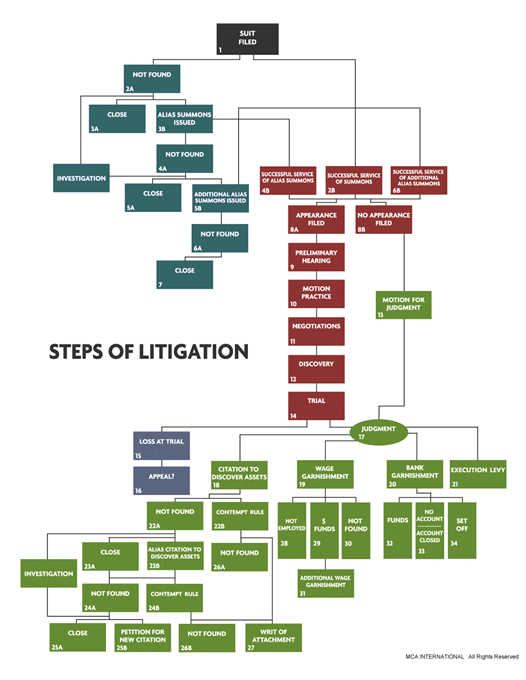
Observe the above sample flow-chart which speaks about the different steps involved in filing a simple lawsuit. Are you surprised that national averages in several courts across the globe often exceeds several years[xvii]? Further analysis helps us understand that in most jurisdictions, courts and court-recognized conflict-resolution mechanisms are the central (nearly monopolistic) means of dispute resolution; Similar to central banks controlling the flow of capital, courts impact the pace and quality of justice that is served (indeed, a sector ripe for disruption!). How can we improve the pace of judicial redressal without compromising the quality of justice?
Introducing blockchain to courts:
Enough studies have been done on Smart Contracts[xviii] and its potential to change the way we do business; therefore, I have excluded it from my current analysis. However, other applications of blockchain can also act as an impetus for delivery of justice. Decentralization in courts begins much before a dispute even reaches courts.
A big advantage of blockchain comes in form of an effective, secure and immutable method to store the data[xix]. Record keeping is essential for enforcement of laws including for property rights, land ownership, and identify management. A blockchain system has been applied in India[xx] for keeping property records, which currently is second largest cause of legal disputes. In the field of family justice, there are examples of e-marriage and marriage certificates encoded in public and private blockchains.[xxi] Further, blockchain applications offer tools for registering intellectual property, ‘anchoring’ it to the blockchain and protecting it[xxii][xxiii]. Another use for blockchain is for securing evidence (examined below). Finally, two new platforms are trying to replace ‘courts’ with decentralized dispute resolution platforms; the Aragon court resolves legal disputes by anonymous jurors on a blockchain network[xxiv] and Kleros which allows (layman) crowd to decide on a dispute, relying on game theory, overthrowing the central legal system that exists. [xxv]
Online Courts in China-a case-study:
Most of these technologies are at a nascent stage. China though, has invested heavily in digitizing the courtroom. In August 2017, China opened its first internet court, covering internet and intellectual property rights cases, including inter-alia disputes involving online contracts[xxvi]. All legal procedures, such as case filings, evidence submissions, case hearings and ruling delivery can be completed online. The smart internet court includes supervised non-human judges powered by artificial intelligence[xxvii]. This initiative includes a mobile court offered on WeChat that has already handled more than 3 million cases. On-average resolution takes 38 days[xxviii], reducing the time taken by nearly half[xxix]. The entire judicial platform is hosted on a blockchain, addressing the two big risks of security and authenticity for a digital court. It also accepts evidence on blockchain platform which goes through four stages: generation, storage, transmission and submission, and authentication. Blockchain solves the data generation issues by establishing time, place, person, what happened before and after. Essentially, the node acts as a witness. The evidence is tied to a person’s identity which is authenticated. The platform offers typical blockchain benefits: encryption, the ability to electronically sign evidence and cost savings.[xxx] Thus, using AI and Blockchain, access to justice has been simplified and to some extent, decentralized by allowing litigants to access justice from their devices in an secure and transparent manner, and by often, removing lawyers and other intermediaries from the value-chain.
Conclusion:
There is immense pressure on the judicial system globally, and litigation are increasing[xxxi]. Currently, no other country has followed China’s steps for digital courts and attempted to pseudo- decentralize courts. China also is currently using it only for specific disputes. Companies like Kleros and Aragon, offering a decentralized option to courts, are also growing slowly. However, there is potential to use digital courts and apply them to regular litigation and improve access to justice for the common man. Implementing blockchain outside the courtroom, we can reduce the number of new disputes. Implementing technology within the courtroom can help resolve existing disputes quicker by using digital secure courts hosted on blockchains, reducing the time required for sending summons, or authentication of evidence. While we are still far away from a Utopian world of ‘equal justice for all’, blockchain has the potential to push us closer to this goal and it is only a matter of time until blockchain appears in your nearest court or a new ‘decentralized’ court appears near you.
[i] https://www.danielsusskind.com/the-future-of-the-professions
[ii] https://sustainabledevelopment.un.org/sdg16
[iii] https://www.thedailystar.net/law-our-rights/rights-advocacy/news/three-dimensions-access-justice-achieving-sdgs-1716856
[iv] https://bf889554-6857-4cfe-8d55 8770007b8841.filesusr.com/ugd/90b3d6_746fc8e4f9404abeb994928d3fe85c9e.pdf
[v] https://worldjusticeproject.org/sites/default/files/documents/WJP-A2J-2019.pdf
[vi] https://www.insurancebusinessmag.com/ca/news/legal-expenses/how-does-canadas-justice-system-fare-on-a-global-scale-195190.aspx
[vii] http://ojen.ca/wp-content/uploads/Access-to-Justice-Statistics_1.pdf
[viii] https://worldjusticeproject.org/news/why-un-needs-official-sdg-indicator-measuring-access-civil-justice
[ix] https://theconversation.com/slow-expensive-complicated-legal-system-must-be-improved-25382
[x] https://nationalpost.com/news/politics/slow-inefficient-and-costly-canadas-criminal-justice-system-needs-urgent-reform-report-finds
[xi] https://foreignpolicy.com/2016/02/22/a-looming-crisis-for-chinas-legal-system/
[xii] https://www.psychologytoday.com/ca/blog/the-hero-in-you/201812/the-criminal-justice-system-is-broken-and-cant-be-fixed
[xiii] https://www.livemint.com/politics/policy/india-s-justice-delivery-system-has-serious-gaps-shows-report-11573104375448.html
[xiv] https://www.economist.com/middle-east-and-africa/2017/07/01/why-justice-in-africa-is-slow-and-unfair
[xv] https://knowledge.wharton.upenn.edu/article/dysfunctional-justice-whats-wrong-with-the-us-legal-system/
[xvi] https://mcainternational.com/sample-steps-in-litigation/
[xvii] http://data.worldjusticeproject.org/accesstojustice/#/grid; https://www.bc-llp.com/long-breach-contract-case-take-resolve-court/
[xviii] https://blockgeeks.com/guides/smart-contracts/
[xix] https://www.technologyreview.com/s/610836/how-secure-is-blockchain-really/
[xx] https://www.undp.org/content/undp/en/home/blog/2018/Using-blockchain-to-make-land-registry-more-reliable-in-India.html
[xxi] https://www.hiil.org/news/unchaining-access-to-justice-the-potential-of-blockchain/
[xxii] https://www.ipwatchdog.com/2018/02/02/blockchain-technology-solve-copyright-attribution-digital-work/id=93161/
[xxiii] https://www.ey.com/en_gl/advisory/how-blockchain-can-impact-the-intellectual-property-life-cycle
[xxiv] https://www.bitcoininsider.org/article/81335/digital-courts-trial-decentralized-justice-real-world-weighs-verdict
[xxv] https://kleros.io/whitepaper_en.pdf
[xxvi] https://www.merics.org/en/blog/size-matters-alibaba-shapes-chinas-first-court-internet
[xxvii] https://learningenglish.voanews.com/a/robot-justice-the-rise-of-china-s-internet-courts-/5201677.html
[xxviii] http://english.court.gov.cn/2019-12/18/content_37529518.htm
[xxix] http://www.xinhuanet.com/english/2019-12/05/c_138605947.htm
[xxx] https://www.ledgerinsights.com/chinese-court-blockchain-evidence-platform/
[xxxi] https://www.nortonrosefulbright.com/en/knowledge/publications/5ed4f834/2019-litigation-trends-annual-survey
 Strategy in the Age of Decentralization