
Background:
Mumbai, the financial capital of the world’s second largest democracy, is home to a working population of 5.21 Million people. Often referred to as the city which never sleeps, Mumbai alone contributes to 6.61% towards India’s GDP. It is estimated that an average Mumbaikar travels 18 km’s on way to office every day, navigating some of the busiest traffic and congested routes. Yet, in all this confusion and chaos, one organisation is responsible for feeding almost entire middle-class working population- Mumbai Dabbawalla’s. It aims to solve a very simple problem: delivering hot lunch boxes (tiffin’s) to the working population scattered across Mumbai, straight from their homes. This problem though simple, involves a complex pick up and delivery mechanism involving 200 delivery individuals working in perfect synchronisation with each other, with a error rate of less than 0.2% in delivering an average of 300,000 tiffin’s daily. The Dabbawalla’s have been operational since 1890’s in Mumbai and comprise of individuals from the “Varkari” sect and almost all hail from a singular village located in the outskirts of Mumbai. This organisation alone has completely disrupted the restaurant industry providing lunch options to working class citizens of Mumbai. It is a decentralised organisation, with autonomy and decision making left completely at the behest of the delivery individuals.
Operations:
The dabbawallas operations have been perfected over time and have been recognised and rewarded by many global organisations including Forbes, United Nations World Food Program to name a few. The clockwork operations have also received appreciation from many world celebrities and personalities including Prince Charles, Richard Branson, Anil Ambani and the now last mile delivery mogul Jeff Bezos. Most dabbawallas are illiterate (8th graders) but have perfected the art of timely, accurate delivery through a simple code system of alphabets and numbers (indicating names, addresses) written on each dabba. On an average, every tiffin (dabba) changes 6 hands before delivery to the end customer and the same is case in the return journey of the tiffin. Their service is impeccable and remains uninterrupted in even the case of extreme weather and seasonal flooding in Mumbai. To make this process run like a well-oiled machinery the Dabbawallas divide the tiffin’s into various categories and mark the lunch boxes in several ways:
- Abbreviations for collection points
- Colour code for starting station
- Number for destination station
- Markings for handling dabbawalla at destination, building and floor
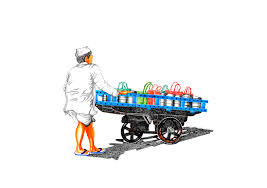
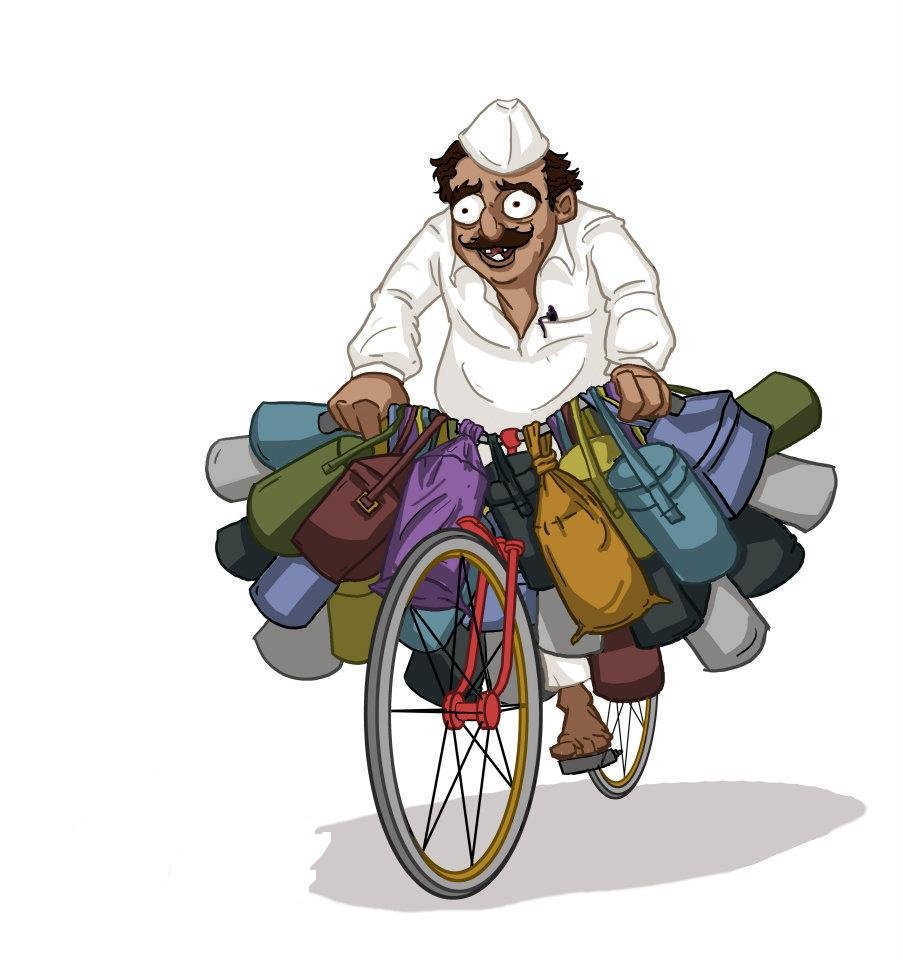
For transportation, they use all means available at their disposal including public transport (buses, trains), bicycles and even deliver on foot. Each Dabbawalla carriers a number of tiffin’s on a wooden cart, colour coded and abbreviated for its destination. The same process is repeated in the journey back to the worker’s home. They themselves can be easily identified rushing through the streets of Mumbai wearing a unique uniform (traditional Indian Kurta pyjama and white Gandhi cap) has become almost like a trademark of the city itself.
Disruption and value Creation:
The Dabbawallas are uniquely placed in the value chain of the industry. Due to low internal costs (transportation and salaries) they charge minimal price to the end cost to customer for their service and because of their efficient operations, customers remain loyal and rarely change behavior. On the contrary, the dabbawallas have seen an annual growth in their customer segment of almost 12% since 2015, due to the novelty and sense of community associated with this service. In the process they have created immense value for the customer by saving time, money and providing convenience at minimal price. The Dabbawalla’s have almost fully captured the market segment of worker’s eating lunch at restaurants, thereby disrupting this ecosystem. The average Mumbai restaurant, even the one’s providing lunch at minimal costs, know that they can’t compete in this space and accordingly target a different market (travelers, students etc) to scale and stay relevant. Their structure is flat, and the work ethic is very strong by virtue of them stemming from a community. The “Varkari’s” have always taken pride in the service and since most of them are related to on another in this tight community, every Dabbawalla is strongly incentivised to perform at maximum efficiency.
Decentralisation of operations and decision making:
The Dabbawallas contribute to a common charitable trust and pool of resources, that provides insurance and occasional financial aid—for example, when a worker needs to replace a bicycle that’s been stolen or is broken beyond repair. They manage themselves with minimal supervision with respect to customer acquisition, retention, logistics and conflict management. Every Dabbawalla acts as an entrepreneur, responsible for negotiating prices with the customer, within a certain bracket. Their own salaries are fixed but are incentivised to acquire profitable customer due to the social equity gained in the community. The relations with the customers are often deep and long term, as Dabbawallas tend to operate in each geographic area over a course of many years. Certain, geographic areas are also given an option of financing their payments, since the organisation itself has a large pool of money that it can rely on. All Dabbawalla’s are equity holders in the organisation and have to invest in the business ten times the amount of expected income to be able to operate in a geographic area. Workers with ten years of experience work as supervisors, defining the sorting, coding and distribution channels of the dabbas.
“The dabbawalas show that with the right system, an organization doesn’t need extraordinary talent to achieve extraordinary performance” – The Times of India.
Prateek Chhikara
 Strategy in the Age of Decentralization