Jenny’s Candle Shop, a fictional digital store, faces increased demand from its customers across the country who want their candles right away. Will a decentralized supply chain solution solve Jenny’s conundrum?
A well-known component of any business, supply chains are meant to depict the flow of value from its source to its consumer. In their most classic sense, supply chains involve raw materials that are sourced and subsequently fabricated in into products that are sold in stores to interested consumers. This phenomenon, presumably a link of nodes, has continued to evolve over time to include various additional nodes that interact with each other. Examples include having multiple suppliers instead of one, and omni-channel sales strategies that simultaneously sell online and in-store. The interconnectedness of these nodes provides opportunities for value creation like never before and has resulted in the formation of supply webs (also referred to as value webs).
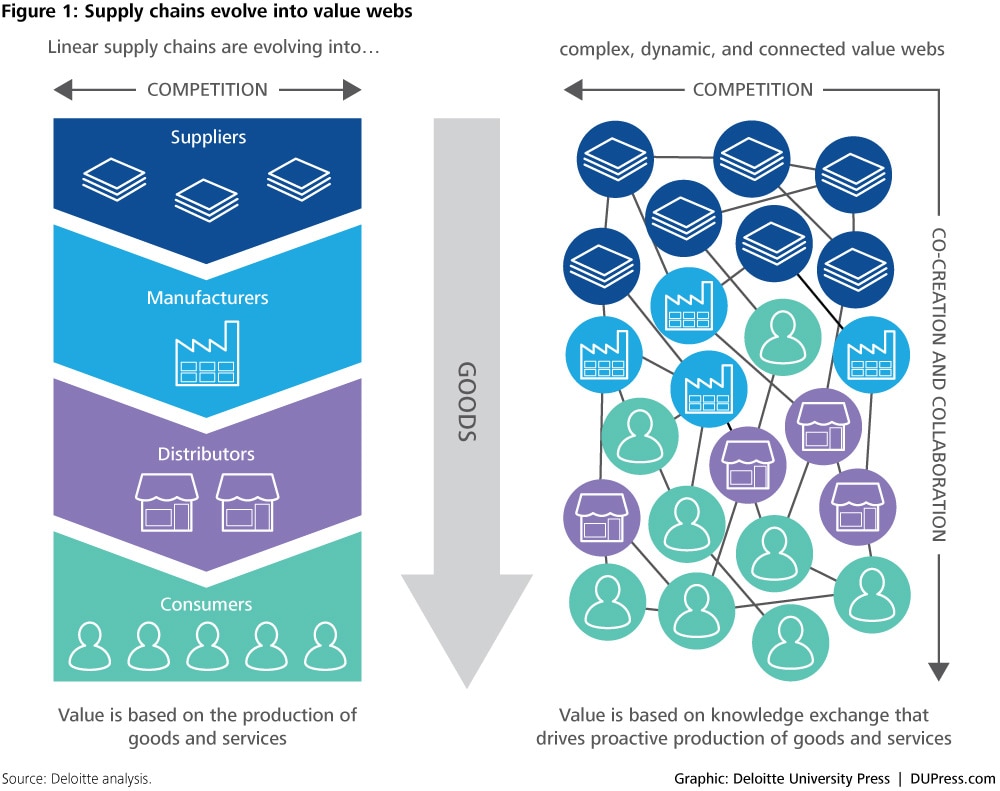
One would think supply webs only apply to large corporations with multiple distribution channels, but the rise of e-commerce has spawned companies with increasingly complex logistics needs- including reverse logistics (a fancy way of saying returns). With over a quarter of the world’s population expected to shop online by 2021, convenience remains the top driver behind digital purchases. A part of that convenience includes the expectation of shorter and shorter shipping times with almost half the shoppers saying same-day delivery increases their propensity to purchase. Of course this isn’t news to Amazon, who is doubling down on same day delivery as a key differentiator by shipping items as low as $1- for free. So how can other, non-Amazon, businesses compete?
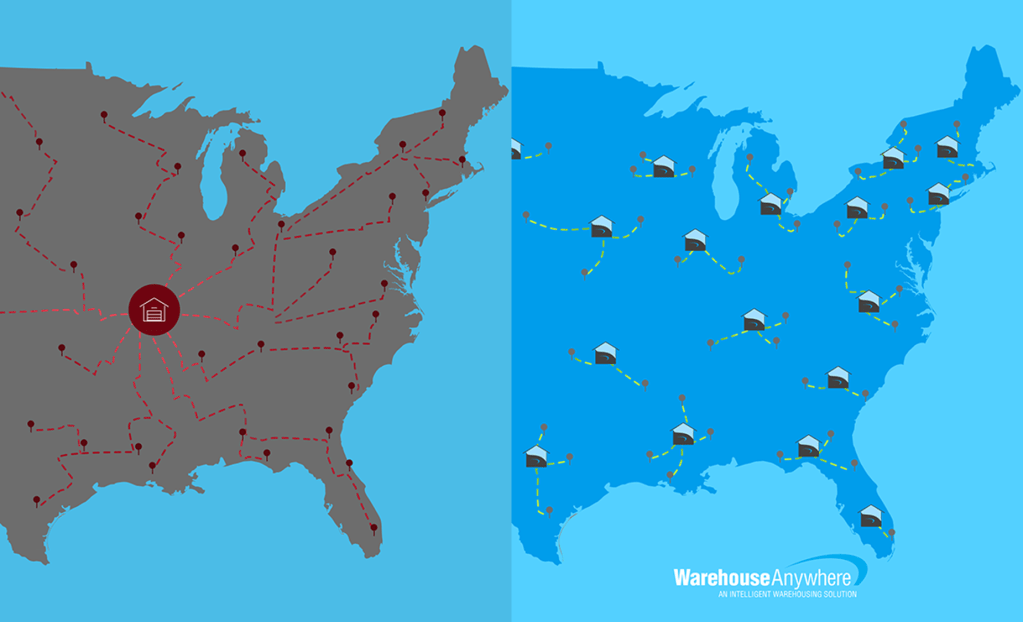
Two-Day delivery promises look attractive to consumers, but many seldom fail to appreciate the complexities and limitations that lie behind ensuring them. The traditional operating model for smaller companies typically involves orders that are fulfilled centrally, and the burden of delivery therefore lies on the fastest shipping method available. So, if Jenny sells hand-made, scented candles online and wants to ship across the country on the same day, she is forced to charge her consumers exorbitant shipping fees and mail her orders by air. On the other hand, and as mentioned before, customers have begun to expect same-day shipping from large retailers and are no longer willing to pay too high a premium. Jenny is thereby forced to regularly make an expensive trade-off for her home business: picking between lower profit margins and lost sales.
A decentralized logistics operating model differs from the traditional model in that the products are stored further away from the corporation’s central location and closer to the customers. In Jenny’s case, she can either own a series of storage facilities across the country that are stocked with candles, outsource her logistics through a third-party logistics provider (3PL), or engage the services of delivery solutions providers such as Deliverr or Warehouse Anywhere.
These incumbents have a decentralized operating model, they own or rent a host of smaller storage facilities nationwide and leverage data to provide storage recommendations to smaller businesses like Jenny’s. Jenny can therefore decide to store her candles across the country in various warehouses that are closest to her customers and that moderate quantities according to geographic demand. The solutions providers go a step further by outfitting their facilities with RFID scanners and boxes with RFID tags so product movement within them is tracked.
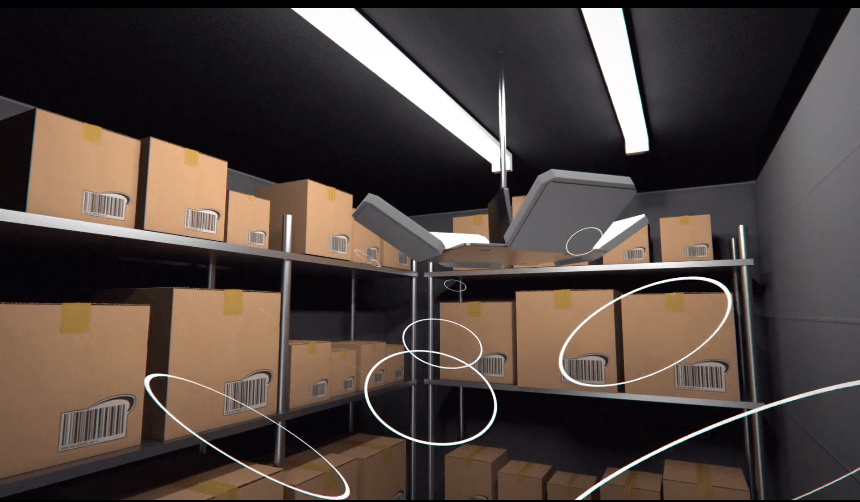
Access to the warehouses is remotely controlled by customers like Jenny, and she has the flexibility of allowing customers to access the warehouse or use carriers to pick up items on her behalf. These decisions can be made at the warehouse-level, so that each facility in effect conducts its own decision making. Perhaps most importantly, both companies have figured out how to divide each storage facility into individual shelf spaces- essentially allowing them to rent out portions of the facility to smaller customers like Jenny. This unbundling provides customers with the ability to stock smaller quantities of their products in more locations without having to rent or buy entire assets. The unbundling phenomenon is reminiscent of what the availability of individual MP3 songs did to CD albums nearly two decades ago.
Decentralized logistics models such as these have some key advantages:
- Small businesses need not build, buy, or even rent entire warehouses
- Warehouses that are close enough to the customers can facilitate faster delivery and unearth avenues such as customer pick-up
- Each warehouse (node) in the network can independently react to the customers closest to it
- Entrepreneurs like Jenny can engage in localized testing before rolling out delivery nationwide
- Returns can be processed with increased efficiency since the customers return their items to the closest warehouse
And naturally, some disadvantages too:
- Two phased shipping – first to the various warehouses, and then again to the end consumers can be costlier than shipping the items directly to consumers upon request
- Greater management is required to account for the decreased control of having a large portion of one’s inventory spread across a large geography
As these organizations grow, they have started to provide their management solutions to traditional storage facility companies as well– an example of how technology can be leveraged to shift a business model such that competitors can be transformed into customers. The model seems to be working right now, with Deliverr raising $40M in its Series C round and promising to bring Two-Day shipping to all of its merchants.
For Jenny, the argument is still not clear cut and requires a greater analysis of the economics. Is faster shipping worth the extra cost of inventory and potential lack of control? How much will her customers’ willingness-to-pay change as a result of her new offering? Will she generate incremental value within the business to justify this change? After all, a decentralized model may not be worth the candle.
 Strategy in the Age of Decentralization